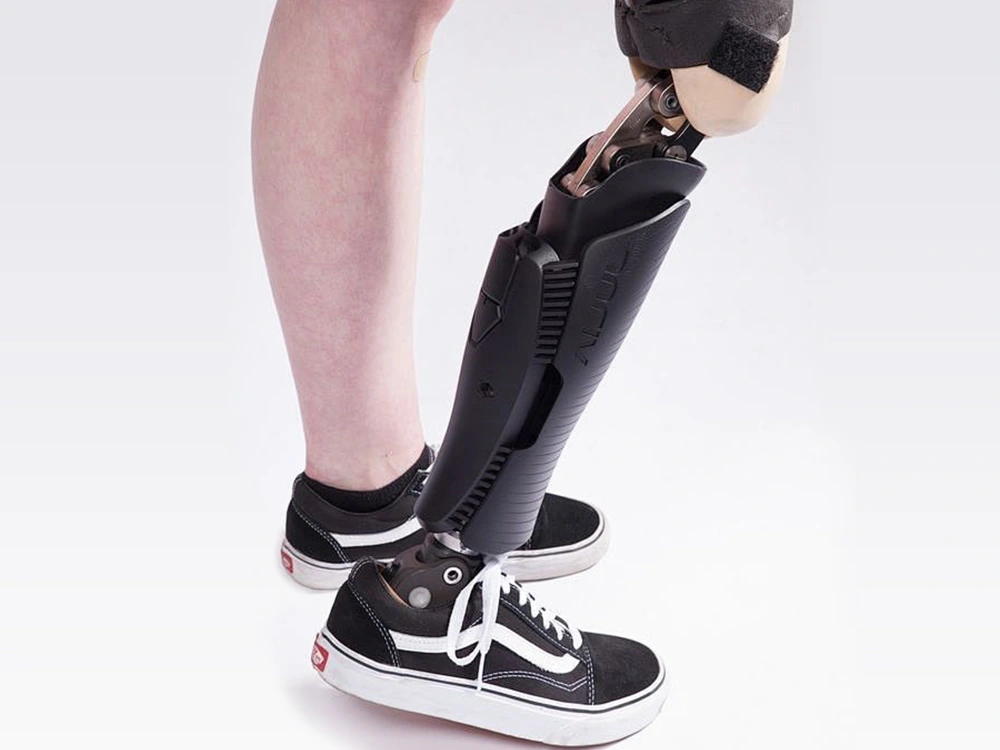

Acrylic, also known as polymethyl methacrylate acrylic (PMMA), is a transparent thermoplastic material widely used in precision manufacturing, display products, medical equipment housings, electronic panels, and custom-machined components. It is selected for applications that require a combination of high optical clarity, lightweight structure, UV resistance, and reliable processing performance.
Acrylic is not a single material type with identical properties. The manufacturing method used to produce acrylic sheets creates different material characteristics, leading to two main categories: cast acrylic and extruded acrylic. These two types differ in production process, thickness consistency, machining behavior, cost, and recommended applications.
This guide explains the essential information engineers, designers, and buyers need when selecting acrylic materials, including what PMMA is, how acrylic sheets are manufactured, how cast and extruded acrylic compare, and which machinable plastics are suitable for CNC machining and laser processing.
Whether you are choosing a material for a new product design or evaluating options for a custom fabrication project, understanding acrylic types and manufacturing characteristics can help you select the right material and processing method more efficiently.
Acrylic is a transparent thermoplastic material made from polymethyl methacrylate (PMMA), a polymer produced through the chemical conversion of methyl methacrylate (MMA) monomers. It is widely used as an engineering plastic when projects require glass-like transparency, lightweight construction, weather resistance, and precise fabrication capabilities.
Unlike general-purpose plastics that are mainly selected for low cost or basic protection, PMMA acrylic is commonly used in applications where appearance, dimensional accuracy, and long-term stability are important. Its combination of optical performance and machinability allows it to be processed through CNC machining, laser cutting, engraving, and other precision manufacturing methods.
The term “acrylic” is the common industrial name, while “PMMA” (polymethyl methacrylate) is the technical material designation used in engineering specifications and manufacturing documents. Because of its transparent appearance and glass-like characteristics, acrylic is also known as “organic glass” or “plexiglass” in many markets.
For material selection, understanding the basic characteristics of PMMA is the first step. Its optical clarity, physical properties, and processing advantages determine why acrylic is widely chosen for transparent components, protective covers, display products, and precision-machined parts.
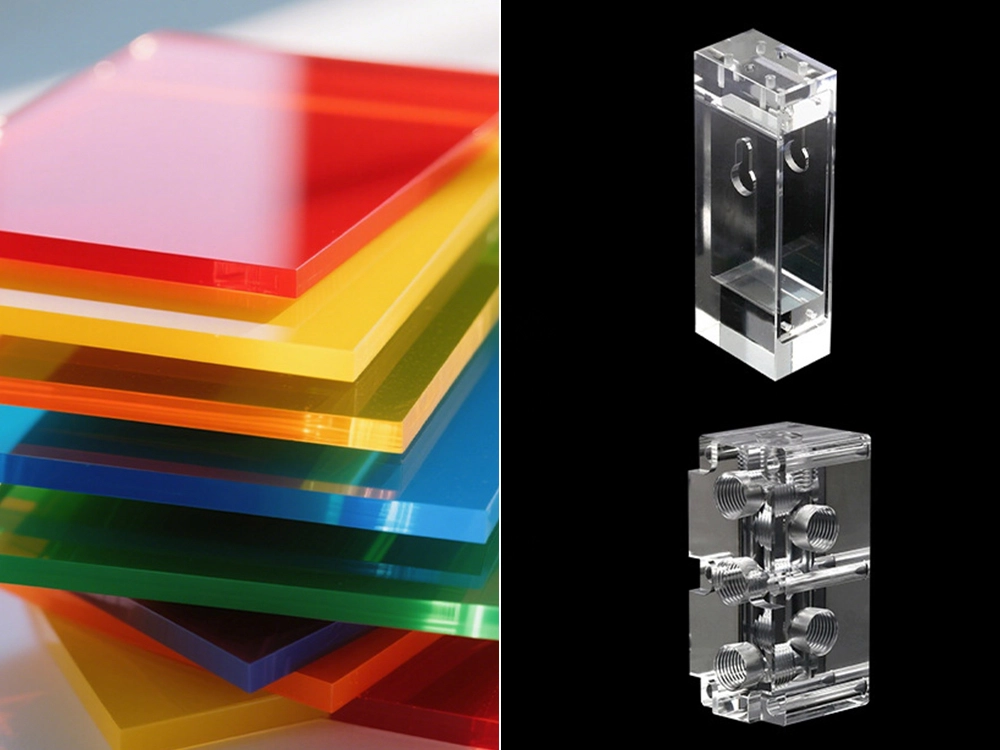
PMMA stands for polymethyl methacrylate, a synthetic polymer created by polymerizing methyl methacrylate (MMA) monomers. The material is classified as a thermoplastic, meaning it can be softened through heating and formed during manufacturing while maintaining its key performance characteristics after cooling.
The chemical structure of PMMA gives acrylic its most important properties, including high transparency, stable surface quality, and resistance to environmental exposure. In industrial specifications, PMMA is identified by its chemical name rather than the general term “acrylic,” allowing engineers and manufacturers to clearly define the material used in a product or machining project.
For engineering applications, PMMA is typically selected when a project requires a transparent material with consistent optical performance and reliable processing characteristics. Its molecular structure allows manufacturers to produce acrylic sheets, rods, and custom components that can be further processed through CNC machining, laser cutting, polishing, and engraving.
The technical distinction between PMMA and acrylic is mainly related to terminology: PMMA refers to the specific polymer material, while acrylic is the broader commercial name used for PMMA-based products. Understanding this difference helps engineers evaluate material specifications and select the appropriate grade for manufacturing requirements.
Acrylic (PMMA) is widely used in precision manufacturing because it combines excellent optical clarity, lightweight construction, UV resistance, and good machining performance. These properties allow acrylic to replace glass in many applications while providing easier processing and greater design flexibility.
The main properties of acrylic include:
Property | Acrylic (PMMA) Performance | Manufacturing Advantage |
Transparency | Up to 92% light transmission | Suitable for optical covers, displays, and transparent components |
Density | Approximately 1.18 g/cm³ | Lighter than glass, reducing overall product weight |
UV Resistance | Excellent resistance to ultraviolet exposure | Suitable for outdoor applications with long-term sunlight exposure |
Surface Hardness | Higher hardness than many common plastics | Provides better scratch resistance and surface appearance |
Machinability | Compatible with CNC machining, laser cutting, and engraving | Supports customized precision manufacturing |
The most recognized feature of acrylic is its high optical transparency. With light transmission reaching more than 92%, clear acrylic can provide a glass-like appearance while maintaining lower weight and easier fabrication. This makes it suitable for products where visibility and aesthetics are important.
Acrylic also performs well in outdoor environments because of its UV resistance and weather stability. Compared with many standard plastics that may experience discoloration or degradation after prolonged exposure, UV-resistant acrylic can maintain its appearance and transparency for extended periods when the correct material grade is selected.
From a manufacturing perspective, PMMA offers good machining flexibility. It can be processed into complex shapes through CNC milling, drilling, polishing, laser cutting, and engraving. However, the final processing performance depends on factors such as acrylic type, sheet production method, part design, and machining parameters. These differences are important considerations when selecting acrylic for a specific application.
Common Applications of Acrylic (PMMA)
Acrylic is commonly selected for products and components that require transparency, durability, and precise fabrication. Its combination of glass-like appearance, low weight, and manufacturing flexibility allows it to serve both visual and functional purposes across multiple industries.
Typical acrylic applications include:
Application Area | Why Acrylic Is Used |
Display products and signage | High transparency, polished appearance, and compatibility with laser cutting and engraving |
Medical equipment housings | Lightweight structure, easy cleaning, and visibility of internal components |
Electronic panels and instrument covers | Stable dimensions, electrical insulation, and premium surface appearance |
Optical components and light covers | Excellent light transmission and consistent optical performance |
Precision industrial parts | Suitable for CNC machining and customized geometries |
In display and signage applications, clear acrylic is widely used for retail fixtures, illuminated signs, display stands, and protective panels. The material can maintain a clean visual appearance while allowing manufacturers to create customized shapes, engraved patterns, and polished edges.
For medical and electronic equipment, acrylic provides a practical balance between protection and visibility. Transparent housings allow users and technicians to observe internal structures while maintaining a lightweight design compared with glass alternatives.
In precision manufacturing, acrylic is often selected when a component needs both functional performance and visual quality. However, different acrylic sheet types can produce different machining results. The next step in material selection is understanding the two major acrylic categories: cast acrylic and extruded acrylic, which are produced through different manufacturing processes and offer different advantages.
Acrylic sheets are mainly divided into two manufacturing types: cast acrylic and extruded acrylic. Both materials are made from PMMA and provide high transparency, but their production methods create differences in internal structure, thickness control, machining performance, and cost.
Understanding these two acrylic types helps engineers and buyers select the right material before fabrication. Cast acrylic is generally associated with higher optical quality and customized manufacturing requirements, while extruded acrylic is commonly chosen for efficient production and standard sheet applications.
Acrylic Type | Manufacturing Method | Main Characteristics | Common Applications |
Cast Acrylic | Liquid MMA monomer is poured into molds and polymerized into sheets | Excellent optical clarity, lower internal stress, better suitability for precision processing | CNC-machined parts, optical components, premium displays |
Extruded Acrylic | PMMA material is continuously heated and pushed through an extrusion die | Efficient production, consistent thickness, lower cost | Standard panels, signs, high-volume sheet applications |
The difference between cast and extruded acrylic does not come from the basic polymer itself, since both are based on polymethyl methacrylate (PMMA). Instead, the manufacturing process changes how the material behaves during cutting, machining, forming, and long-term use.
For projects where appearance, customization, and precision fabrication are the main priorities, understanding the differences between these two acrylic sheet types is essential. The next section compares cast acrylic and extruded acrylic in detail to help determine which option is more suitable for different manufacturing requirements.

The choice between cast acrylic and extruded acrylic depends on the required machining method, production volume, dimensional accuracy, surface quality, and project budget. Although both materials are made from PMMA and provide similar transparency, their different manufacturing processes make them suitable for different applications.
For precision manufacturing projects, cast acrylic is usually preferred when the design requires complex machining, customized dimensions, or a high-quality surface finish. Extruded acrylic is often selected for standard sheet applications, large-volume production, and projects where cost efficiency is a priority.
Selection Factor | Cast Acrylic | Extruded Acrylic |
Manufacturing process | Individual sheet casting through mold polymerization | Continuous extrusion production |
Optical quality | Excellent clarity and surface finish | Good transparency for general applications |
Thickness options | More flexible for customized thickness requirements | Mainly available in standard thickness ranges |
Dimensional tolerance | Suitable for applications requiring tighter control | Consistent for large-volume standard production |
CNC machining | Better choice for complex parts and precision fabrication | Suitable for simpler machining operations |
Laser cutting | Good performance with high-quality results | Efficient for high-volume cutting projects |
Material cost | Higher due to slower production process | Lower due to continuous manufacturing efficiency |
A simple selection guide can help determine the appropriate acrylic type:
Choose cast acrylic when:
The part requires CNC machining or detailed engraving.
Tight dimensional accuracy is important.
Surface appearance and optical quality are critical.
The component has complex shapes or precision features.
Choose extruded acrylic when:
The project requires large quantities of standard sheets.
Laser cutting is the main processing method.
Production cost and efficiency are major considerations.
The application does not require advanced machining performance.
The correct acrylic choice should be based on the entire manufacturing process rather than material appearance alone. Selecting the appropriate sheet type before fabrication can improve machining reliability, reduce processing issues, and help achieve better final product quality.
Acrylic (PMMA) is manufactured by converting methyl methacrylate (MMA) monomers into a solid polymer through a controlled polymerization and forming process. The production process determines the final material characteristics, including transparency, thickness consistency, surface quality, and suitability for different fabrication methods.
Although acrylic products may appear similar after production, manufacturing conditions directly influence how the material performs during later processing. Factors such as polymer structure, cooling control, and sheet forming methods can affect dimensional stability and machining reliability.
The basic acrylic manufacturing process includes the following stages:

The manufacturing process begins with methyl methacrylate (MMA), the primary raw material used to create PMMA. The monomer is purified and prepared to ensure stable polymerization and consistent material performance.
During polymerization, MMA molecules are linked together to form long-chain PMMA polymers. Manufacturers carefully control reaction conditions, including temperature, time, and chemical additives, to achieve the required optical clarity, mechanical strength, and material stability.
After polymerization, PMMA is processed into acrylic sheets through different forming methods:
Casting process: Liquid MMA is placed into molds and polymerized into individual sheets.
Extrusion process: PMMA material is heated and continuously pushed through a forming die to create sheets with consistent dimensions.
After forming, acrylic sheets undergo controlled cooling to reduce deformation and maintain dimensional stability. The sheets are then cut into standard sizes and prepared for further processing.
Manufacturers inspect acrylic sheets based on key parameters such as transparency, thickness accuracy, surface defects, and dimensional consistency. These quality checks ensure that the material meets requirements for industrial applications and precision fabrication.
The production process does more than determine how acrylic sheets are made; it also affects how consistently the material performs during cutting, machining, and finishing. Understanding these manufacturing factors helps engineers select acrylic materials that match the requirements of their final application.
The quality control of acrylic manufacturing directly influences the material’s machining consistency, dimensional accuracy, and long-term performance. Even when acrylic sheets are produced from the same PMMA material, differences in polymerization control, cooling conditions, and finishing processes can affect how the material behaves during fabrication.
Several manufacturing factors influence acrylic performance:
Manufacturing Factor | Impact on Acrylic Performance |
Polymerization control | Affects optical clarity, molecular stability, and overall material consistency |
Cooling process | Helps reduce deformation and maintain dimensional stability |
Thickness control | Influences machining accuracy and final part dimensions |
Surface treatment | Determines surface smoothness, appearance, and finishing requirements |
Internal stress management | Affects cracking resistance and fabrication reliability |
During precision manufacturing, acrylic sheets with better structural stability are easier to process into accurate components. Poorly controlled production conditions may lead to issues such as uneven thickness, surface defects, or inconsistent machining results, especially in applications requiring tight tolerances.
For CNC machining, laser cutting, and other precision fabrication methods, material consistency is as important as the basic properties of PMMA itself. Stable acrylic sheets allow manufacturers to achieve more predictable cutting behavior, cleaner edges, and improved repeatability across multiple production batches.
Therefore, acrylic selection should consider not only the material category but also the quality standards of the sheet production process. A well-manufactured acrylic sheet provides a more reliable foundation for precision machining and customized component production.
Machinable plastics are engineering plastics that can be cut, milled, drilled, or shaped into accurate components while maintaining stable dimensions and surface quality. Acrylic (PMMA) is one of the most widely used transparent machinable plastics, but materials such as polycarbonate (PC), ABS, and POM may provide different advantages depending on mechanical requirements, environmental conditions, and manufacturing goals.
When selecting a machinable plastic, engineers typically evaluate several factors, including transparency, impact resistance, dimensional stability, chemical resistance, machining difficulty, and material cost. The best material choice depends on whether the priority is optical appearance, mechanical strength, precision performance, or production efficiency.
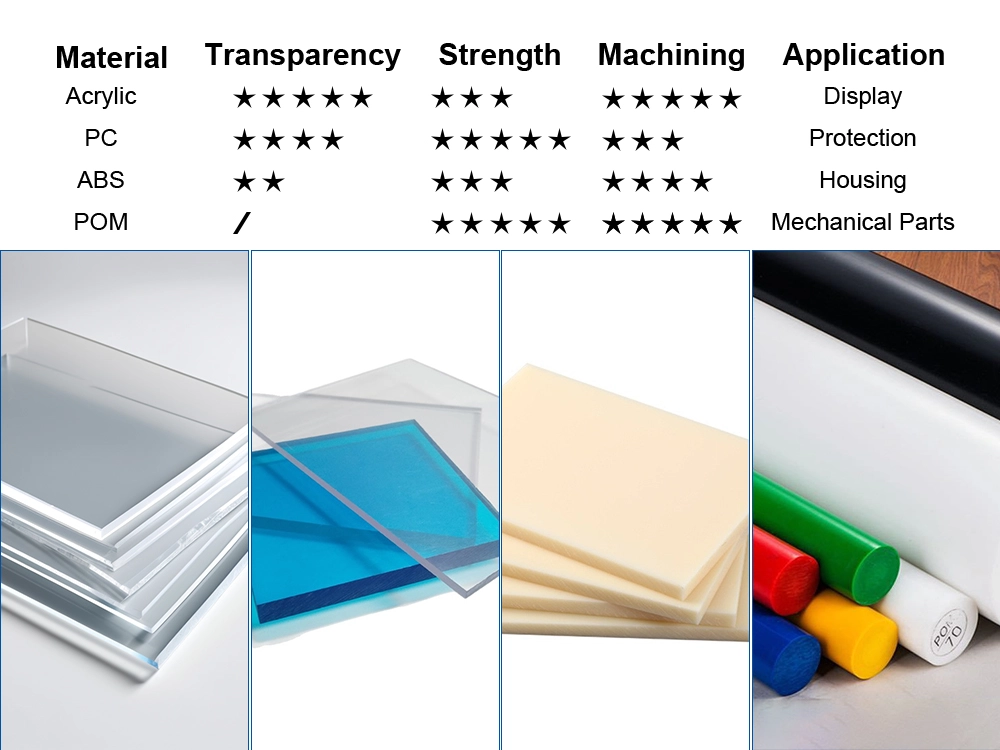
Material | Transparency | Machining Performance | Main Advantages | Common Applications |
Acrylic (PMMA) | Excellent, up to 92% light transmission | Easy to CNC machine and laser process | Optical clarity, UV resistance, smooth surface finish | Display panels, optical covers, transparent housings |
Polycarbonate (PC) | Good transparency | Moderate machining difficulty | Higher impact resistance and toughness | Safety covers, protective components |
ABS | Limited transparency | Easy processing | Low cost and good impact resistance | Product housings, prototypes |
POM (Acetal) | Opaque | Excellent precision machining performance | High stiffness, low friction, dimensional stability | Mechanical parts, gears, precision components |
Acrylic is often chosen when a project requires a combination of transparency, appearance, and fabrication flexibility. Compared with other machinable plastics, PMMA provides better optical performance than ABS or POM and better scratch resistance than many transparent alternatives.
However, material selection should always match the application requirements. Polycarbonate may be more suitable where impact protection is the priority, while POM may perform better in mechanical components requiring low friction and high wear resistance.
Understanding the differences between machinable plastics allows engineers to select materials more effectively before moving into CNC machining, laser processing, or other fabrication stages. The following section focuses specifically on how acrylic compares with other commonly used engineering plastics.
Acrylic (PMMA), polycarbonate (PC), ABS, and POM are all commonly used machinable plastics, but they are designed for different performance requirements. Acrylic is mainly selected for transparency and visual quality, while other plastics may provide advantages in impact resistance, mechanical strength, or wear performance.
Acrylic vs Polycarbonate (PC)
Acrylic and polycarbonate are often compared because both are transparent engineering plastics. The main difference is the balance between optical performance and mechanical strength.
Acrylic provides:
Polycarbonate provides:
Feature | Acrylic (PMMA) | Polycarbonate (PC) |
Transparency | Excellent, up to 92% light transmission | Good transparency |
Impact resistance | Moderate | Very high |
Scratch resistance | Better surface hardness | Lower without protective coating |
UV resistance | Excellent | Depends on material grade |
Machining characteristics | Easier to achieve smooth finishes | Requires more process control |
Acrylic vs ABS
ABS is a cost-effective engineering plastic widely used for structural housings and prototypes. Compared with acrylic, ABS offers better toughness but lacks transparency and optical performance.
Acrylic is preferred when the component requires:
ABS is preferred when the component requires:
Acrylic vs POM
POM (Acetal) is designed for mechanical applications rather than visual applications. It provides excellent stiffness, low friction, and dimensional stability, making it suitable for gears, bearings, and moving components.
Acrylic is more suitable for:
POM is more suitable for:
Material | Best Used For |
Acrylic (PMMA) | Transparent, visually important precision components |
Polycarbonate (PC) | High-impact transparent protection |
ABS | Low-cost structural parts and prototypes |
POM | Mechanical parts requiring strength and wear resistance |
For projects requiring transparent precision components, acrylic remains one of the most practical machinable plastics because it combines optical performance, weather resistance, and processing flexibility. When mechanical strength or impact resistance becomes the main requirement, alternative materials such as polycarbonate or POM may provide better performance.
CNC acrylic machining uses computer-controlled cutting tools to manufacture custom PMMA components with accurate dimensions, smooth surfaces, and complex geometries. Compared with basic sheet cutting methods, CNC machining provides greater design flexibility and allows manufacturers to create features such as pockets, holes, grooves, curved profiles, and precision mounting structures.
Acrylic is suitable for CNC machining because it can achieve high-quality surface finishes while maintaining dimensional accuracy when processed with appropriate tooling and cutting parameters. However, machining performance depends on several factors, including acrylic type, part design, material thickness, tool selection, and production requirements.
Important CNC acrylic machining capabilities include:
Machining Factor | Description |
Dimensional tolerance | Controlled according to part geometry, material stability, and manufacturing requirements |
Complex geometries | Supports pockets, holes, contours, grooves, and customized structures |
Surface finishing | Can achieve smooth edges through optimized cutting and polishing processes |
Material thickness | Suitable for various acrylic sheet thicknesses based on application needs |
Repeatability | CNC control enables consistent production across multiple parts |
During CNC processing, acrylic requires carefully controlled machining conditions. Excessive cutting force or unsuitable parameters may generate heat, which can cause melting, stress marks, or surface defects. Professional acrylic machining typically involves optimized spindle speed, feed rate, tooling selection, and finishing techniques to maintain clean edges and accurate dimensions.
CNC acrylic machining is commonly used for applications including medical equipment covers, optical components, electronic housings, laboratory parts, display fixtures, and custom industrial components. For these applications, manufacturers need to evaluate not only CNC equipment capability but also experience with PMMA processing, tolerance control, and quality inspection procedures.
When a project requires transparent precision parts with complex designs, CNC machining provides a practical solution by combining acrylic’s optical advantages with flexible manufacturing capability. Selecting the appropriate acrylic grade and machining process at the design stage helps achieve better performance and production consistency.
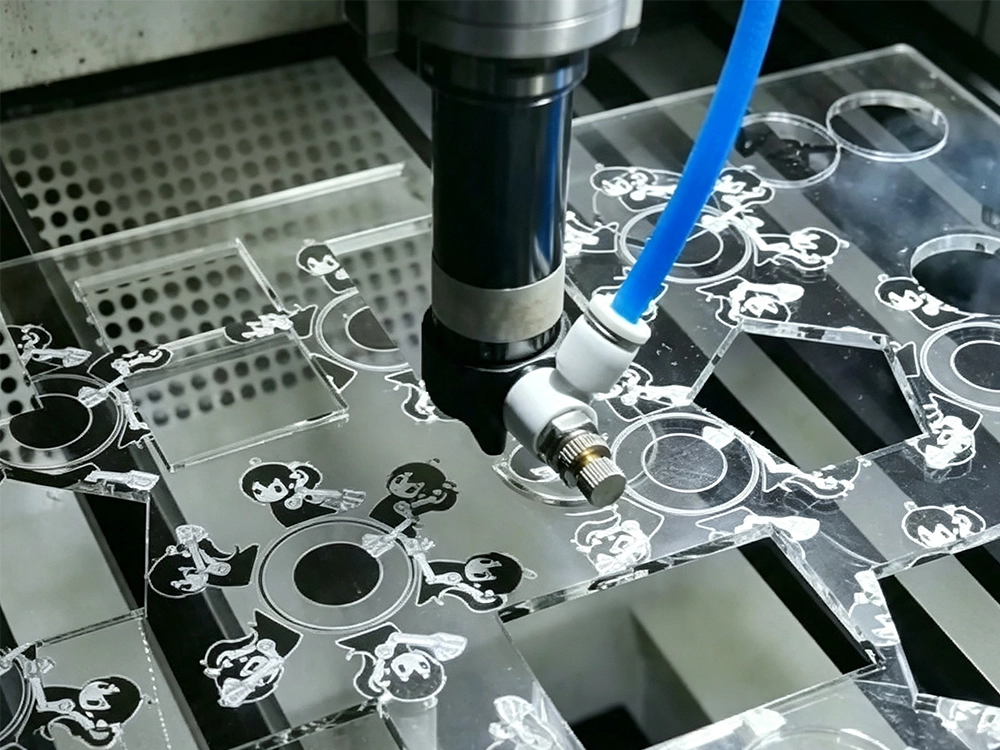
Laser cutting and engraving are widely used acrylic processing methods for creating precise two-dimensional shapes, detailed surface patterns, and customized designs. Compared with mechanical cutting methods, laser processing uses a focused beam to remove material with minimal physical contact, making it suitable for applications that require clean edges, fine details, and efficient production.
Laser cutting is commonly used for acrylic sheets because it can produce smooth edges with high repeatability. When appropriate laser parameters are applied, clear acrylic can achieve polished-looking cut edges without extensive secondary finishing. This makes laser processing particularly suitable for visual products where appearance quality is important.
Key advantages of laser processing acrylic include:
Processing Method | Main Advantages | Typical Applications |
Laser Cutting | Smooth edges, accurate profiles, efficient production | Acrylic signs, panels, display components |
Laser Engraving | Fine surface details and customized markings | Logos, text, patterns, decorative designs |
CNC Machining | Three-dimensional processing and complex structures | Industrial parts, housings, precision components |
Common applications of laser engraving acrylic include:
Laser cutting and CNC machining serve different manufacturing purposes. Laser cutting is generally more suitable for flat acrylic sheets and two-dimensional profiles, while CNC machining is preferred for three-dimensional parts requiring holes, pockets, grooves, or mechanical structures.
The choice of acrylic processing method should consider the final product design, required accuracy, production volume, and surface finish requirements. Combining the correct acrylic material with the appropriate fabrication process helps manufacturers achieve better efficiency, appearance, and product consistency.
Acrylic and polycarbonate are both transparent engineering plastics, but they are used for different priorities. Acrylic offers better optical clarity, higher surface hardness, and stronger UV resistance. Polycarbonate offers much higher impact resistance and toughness.
If the project needs a premium clear appearance, outdoor stability, or easy fabrication, acrylic is usually the better choice. If impact protection and break resistance are more important, polycarbonate is often more suitable.
Acrylic is better than many common plastics when the project needs clarity, appearance, UV resistance, and precision machining. It has a glass-like look and performs well in transparent or decorative applications.
However, acrylic is not always the best option. Some plastics, such as ABS, PP, or POM, may be better for lower cost, impact resistance, flexibility, or wear performance.
Yes. Acrylic has excellent UV resistance and is widely used in outdoor applications because it maintains clarity and appearance better than many standard plastics.
It is commonly chosen for outdoor signs, lighting covers, architectural panels, and transparent protective parts. For harsh environments, the exact acrylic grade should still be checked.
Acrylic is not harder than glass, but it is often more practical because it is lighter, less brittle, and more impact resistant. It is about half the weight of glass and is much easier to cut, drill, and shape.
Glass still wins in scratch resistance and some high-temperature or chemical environments. Acrylic is usually preferred when weight reduction, safety, and custom fabrication matter more than maximum surface hardness.
Selecting the right acrylic material requires considering the complete manufacturing process, including material type, production method, machining technology, and final application requirements. Although most acrylic sheets share similar transparent characteristics, differences in PMMA grades and manufacturing methods can directly affect machining accuracy, surface quality, durability, and production efficiency.

A practical selection approach can help match acrylic materials with different project requirements:
Project Requirement | Recommended Acrylic Solution |
Transparent display products | Clear acrylic with high optical clarity and polished surface quality |
Outdoor applications | UV-resistant acrylic suitable for long-term weather exposure |
CNC precision components | Cast acrylic for improved machining stability and complex part fabrication |
Large-volume sheet production | Extruded acrylic for cost efficiency and consistent dimensions |
Laser engraving projects | Acrylic grades designed for clean engraving results |
Custom industrial parts | CNC-machined acrylic based on required tolerances and geometry |
Before manufacturing begins, engineers should evaluate several key factors:
For projects requiring transparent precision parts, acrylic provides a flexible solution by combining optical performance with manufacturing adaptability. Choosing the correct PMMA material and fabrication method at the beginning of the design process can reduce processing challenges and improve final product consistency.
Whether you need standard acrylic sheets or customized CNC acrylic components, professional material evaluation and manufacturing support can help identify the most suitable solution for your application. Uploading technical drawings and project requirements allows manufacturers to recommend the appropriate acrylic type, machining method, and production approach.
Acrylic (PMMA) is a versatile transparent engineering plastic that combines optical clarity, lightweight construction, UV resistance, and flexible manufacturing options. From display products and protective covers to CNC-machined precision components, acrylic provides a practical alternative to glass and other plastics when both appearance and performance are important.
Choosing the right acrylic solution depends on several key factors:
For engineers, designers, and manufacturers, acrylic selection should not be based only on transparency or appearance. A successful result requires matching the PMMA material type, fabrication method, and performance requirements with the final application.
Whether you need standard acrylic sheets, laser-cut components, or custom CNC-machined acrylic parts, choosing the right material and manufacturing approach can improve product quality, reduce processing challenges, and achieve more reliable results. A professional evaluation based on drawings, specifications, and application requirements can help identify the most suitable acrylic solution for your project.
Acrylic Material Selection Checklist
Before starting an acrylic manufacturing project, engineers and buyers can use the following checklist to confirm whether the selected material and processing method match the application requirements.
Selection Item | Key Questions |
Acrylic type | Is cast acrylic or extruded acrylic more suitable for the project requirements? |
Optical requirements | Does the application require maximum transparency, light transmission, or visual appearance? |
Mechanical requirements | Is the component exposed to impact, stress, vibration, or mechanical loads? |
Processing method | Will the part be CNC machined, laser cut, engraved, or fabricated through another process? |
Dimensional accuracy | Are tight tolerances or complex geometries required? |
Environmental conditions | Will the acrylic part be exposed to sunlight, moisture, chemicals, or temperature changes? |
Surface finish | Does the final product require polished edges, scratch resistance, or premium appearance? |
Production volume | Is the project a prototype, small batch, or high-volume production run? |
Acrylic is an effective material choice when the project requires a balance between transparency, durability, appearance, and manufacturing flexibility. However, selecting the wrong acrylic type or processing method may lead to unnecessary machining difficulties, higher production costs, or reduced product performance.
A well-planned material selection process helps ensure that acrylic components achieve the required functional performance while maintaining visual quality and manufacturing efficiency. By evaluating the application requirements before production begins, manufacturers can select the appropriate PMMA grade, acrylic sheet type, and fabrication method for long-term reliability.
Stop thinking more, fill out the blank below, and send us an inquiry, and you will have a professional team of board game custom products contact you to answer any questions and provide pricing.
You can send us any questions to get any information you would like to know, and we will respond to you in extremely short time.