

A Practical Guide to Avoiding the Most Common Rework Failures — Especially on Zinc Die-Cast Parts
Stripping chrome sounds like a routine prep step, until a part is ruined in seconds. In a documented forum case, a user submerged two zinc-alloy guitar tuner housings in hydrochloric acid; in less than a minute, the internal mounting threads corroded beyond repair, turning both parts into scrap. In practice, the real challenge of chrome removal is rarely whether the plating will come off—it is how fast and irreversibly the stripping process attacks the base metal underneath.
There are three primary methods to strip chrome from metal: mechanical abrasion, chemical immersion, and reverse electroplating. However, success does not depend on the method alone—it depends on whether your substrate can survive it. While steel and copper alloys offer a relatively wide margin for error, zinc die-cast parts (pot metal) are far less forgiving: choosing the wrong stripping method often leads to immediate, irreversible failure.
Pot metal (typically zinc die-cast alloy) should not be soaked in strong acids or strong alkalis, and reverse electroplating is generally not recommended. Because zinc-based castings react aggressively with common chemical strippers, mechanical abrasion and polishing remain the only reliably safe standard method for removing chrome from pot metal without risking structural loss.
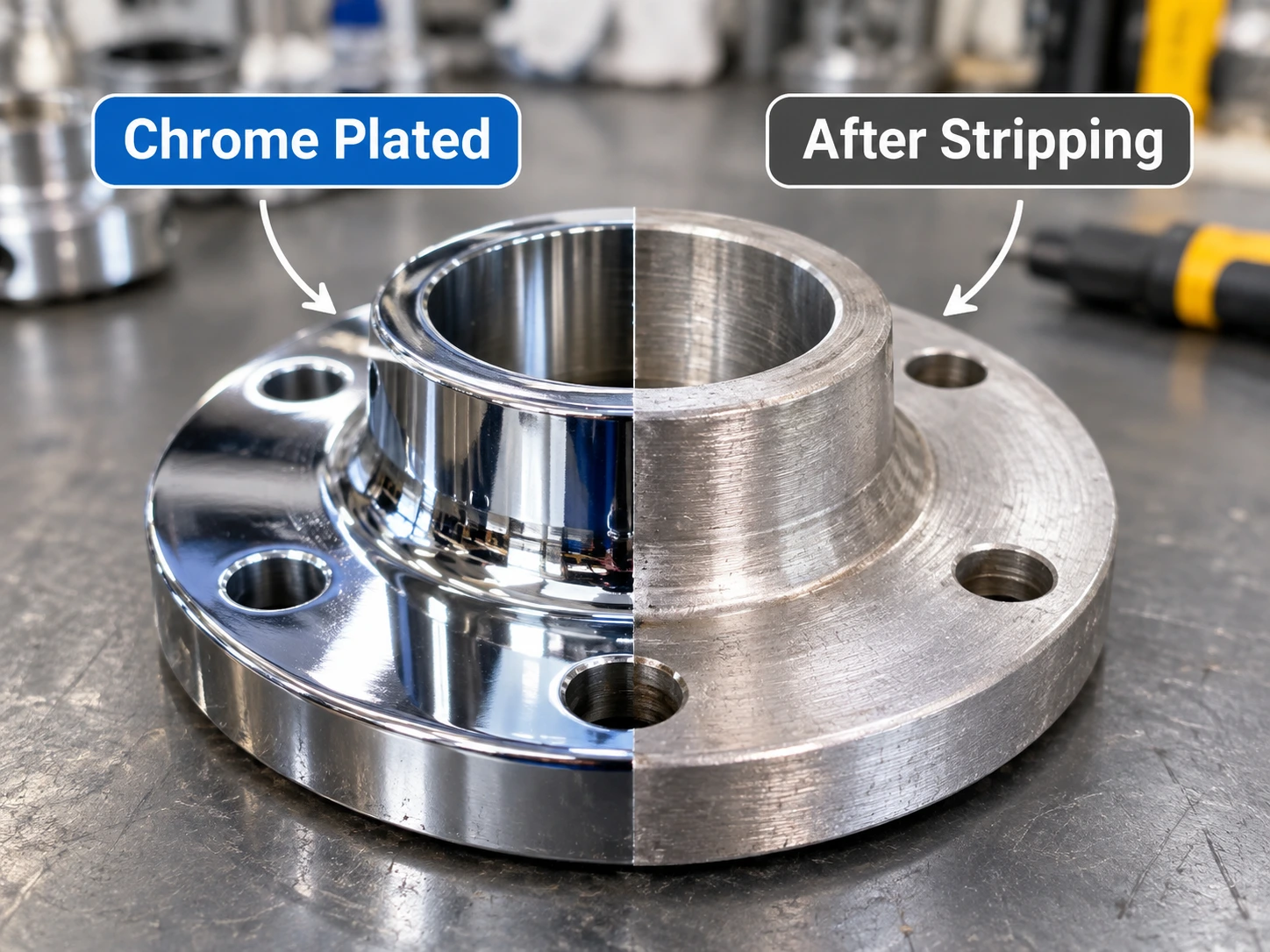
Chemical mismatch is not a theoretical risk—it is a recurring failure mode documented across metalworking and restoration forums:
Internal thread destruction in under a minute: In a forum report from Les Paul Forum (Cogswell, 2008), a user immersed two zinc-alloy guitar tuner housings in hydrochloric acid to remove the chrome. In less than 60 seconds, the acid severely corroded the internal mounting threads. The bushings could no longer be installed, and both housings were immediately scrapped.
Base metal erosion from steel-grade acid: An independent user report on finishing.com (Tom H., 2000) documented a similar failure when an acid pickling solution intended for steel was applied to pot metal, resulting in direct substrate attack rather than controlled plating removal.
As noted in restoration industry guidance (such as Iverson Automotive), the true condition of a zinc die-cast part is often hidden until the old plating is removed. When defects appear after stripping, distinguishing between pre-existing casting flaws and process-induced damage is critical for rework decisions:
| Observed Phenomenon | Accurate Technical Explanation |
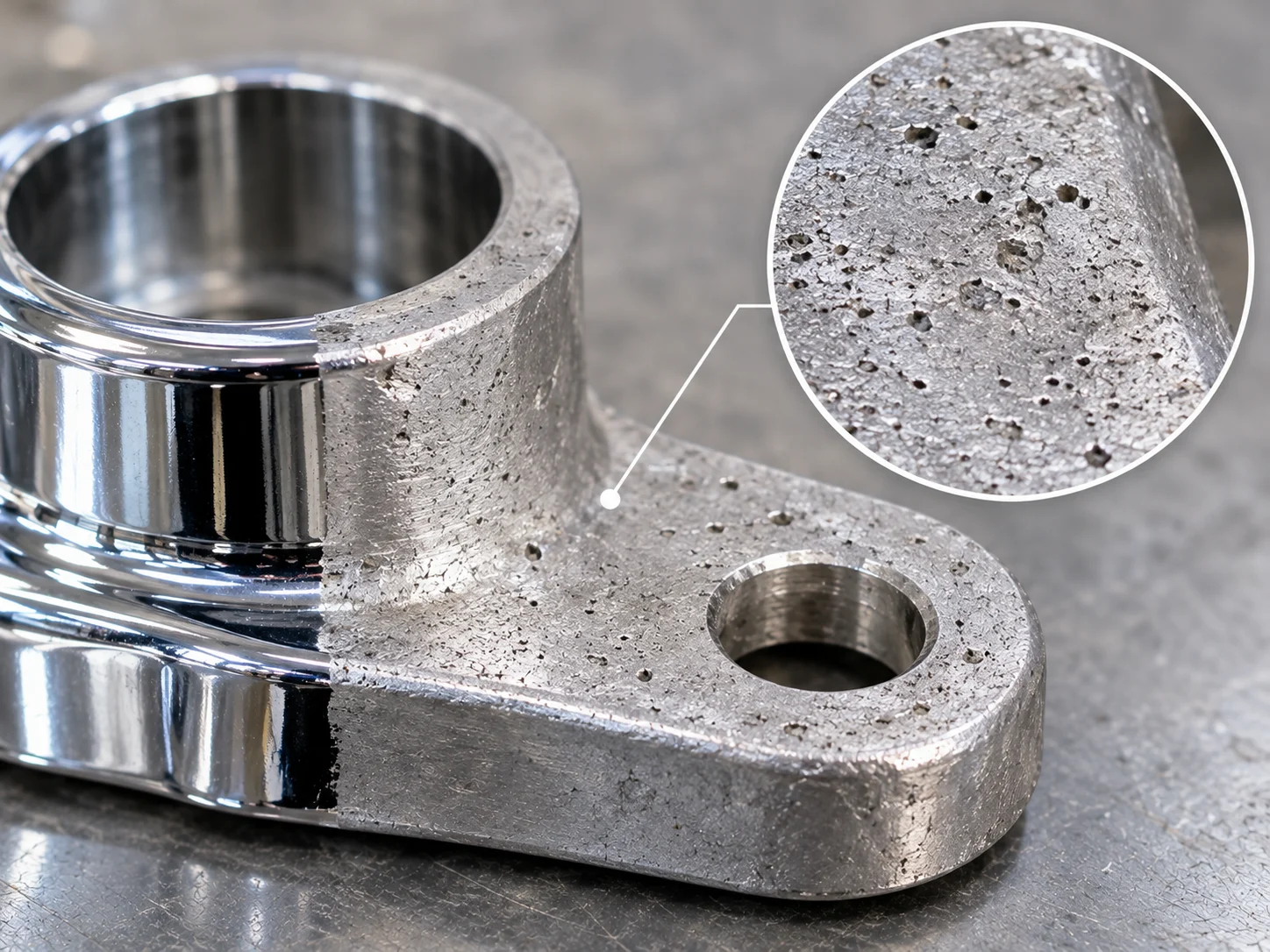
Existing porosity exposed during sanding | Internal voids formed during the original die-casting process that are opened up by mechanical abrasion—not caused by chemical stripping. |
Pitting looks worse than expected on old parts | Pre-existing corrosion underneath the old plating that only becomes fully visible once the surface layers are removed. |
New or rapidly worsened pitting after stripping | Process mismatch: the chemical stripping solution itself has actively corroded the zinc substrate. |
Decorative chrome plating on pot metal is rarely a single layer; it is typically a three-layer system consisting of Copper (Cu) → Nickel (Ni) → Chrome (Cr). Removing the thin outer chrome layer does not bring the part down to bare metal.
Attempting to chemically strip deeper layers carries its own severe risks. In a documented operational case on finishing.com (Daniel Huntsman, 2002), using a nickel-stripping solution on pot metal caused noticeable pitting on the substrate—a clear reminder that even when the outer chrome is gone, chemical nickel removal (distinct from chrome stripping) can still compromise zinc castings.
It is also important to separate decorative pot metal restoration—such as classic automotive trim inquiries like a Chrysler grille (finishing.com, Roger Dacey, 2007)—from industrial functional hard chrome stripping and replating. Industrial rework on hydraulic rods, rollers, and molds (as handled by industrial platers like Altaş Kromaj) operates on heavy ferrous substrates under completely different chemical and dimensional tolerances.
Ultimately, these cases do not just illustrate the obvious point that “stripping carries risk”. They highlight that the highest risks hide in unseen geometries—internal threads, thin walls, and bushing seats—the exact features most likely to be overlooked before stripping, and impossible to recover once damaged.
Once you understand why pot metal leaves almost no margin for chemical error, it becomes much easier to match the three chrome stripping methods to the right base metal—and control the operating parameters that keep the substrate intact.
| Base Metal | Recommended Method | Key Parameter / Process Rule |
| Steel | Alkaline electrolytic stripping | Avoid acid immersion; ~1 A/sq in (light) or 140°F at ~1 A/cm² (heavy) |
| Brass / Bronze / Copper / Nickel Alloys | Hydrochloric acid (HCl) immersion | No electricity needed; room-temp concentrated HCl or 125°F dilute HCl |
| Pot Metal (Zinc Die-Cast) | Mechanical abrasion & polishing | Use mild media and light pressure; inspect in stages to limit exposed porosity |
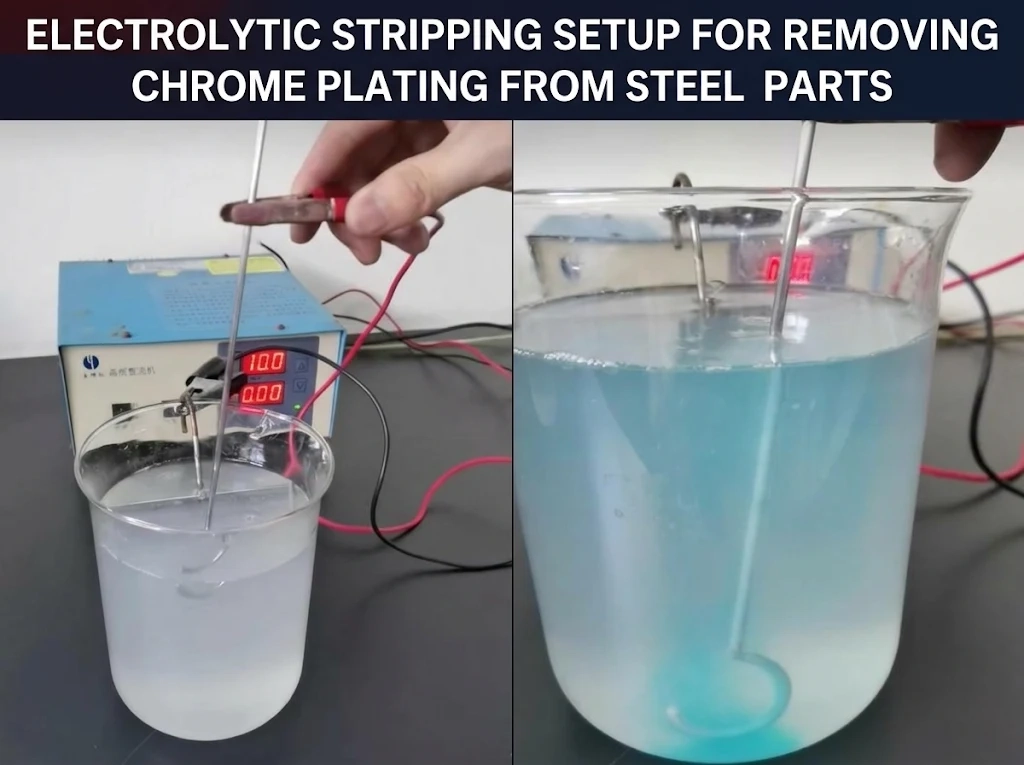
Alkaline electrolytic stripping is the standard, preferred method for steel—do not use acid immersion on steel parts. Choosing the right operating parameters depends primarily on deposit thickness:
Light chrome deposits (≤0.002″): Use electrolytic stripping at a current density of approximately 1 A/sq in. Monitor the tank and stop the process as soon as gas bubbling ceases or the ammeter reading drops sharply.
Heavy chrome deposits (≥0.002″): Alkaline electrolytic stripping is significantly more effective than acid immersion.
Stripping rate comparison: According to industry process data (finishingandcoating.com), a fresh acid stripping bath removes chrome at roughly 0.0003 in/hr, dropping to around 0.00015 in/hr as the bath ages. By contrast, alkaline electrolytic stripping (operating at roughly 140°F and a current density of ~1 A/cm²) reaches stripping rates of about 0.003 in/hr—nearly 10 times faster.
Normal post-strip appearance: Steel surfaces commonly darken after chrome removal due to carbon precipitation (carbon smut). This is normal; the part simply needs mechanical polishing before replating.
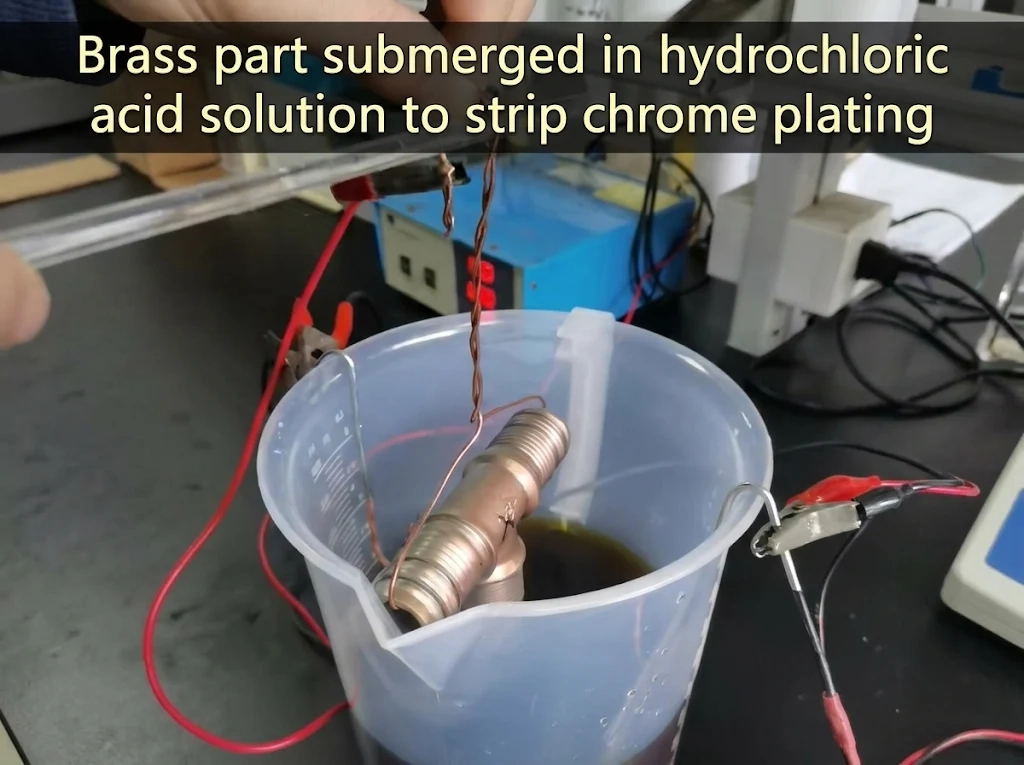
Copper- and nickel-based alloys can be stripped safely using hydrochloric acid immersion with no electrical current required (emeraldcoatings.com):
Room-temperature bath: Soak the part in concentrated hydrochloric acid at room temperature until the chrome layer clears.
Accelerated dilute bath: To speed up stripping without using full-strength acid, mix a dilute solution (approximately 1 pint of hydrochloric acid per 1 gallon of water) and heat the bath to about 125°F.
Critical safety rule: Always add acid slowly to water—never pour water into acid.
Stick to controlled mechanical abrasion and polishing rather than chemical or electrolytic tanks.
Control media and pressure: Use mild abrasive media and light, even pressure to remove the plating gradually.
Inspect in stages: Check the surface frequently during sanding or buffing so you do not cut deeper than necessary and open up additional internal casting porosity.
This restriction does not exist because zinc alloy is inherently “more fragile” than steel or brass—it exists because standard chemical and electrolytic stripping methods have far too low a margin for error on pot metal.
Whether you are handling a part in-house or evaluating a supplier’s rework capability, confirming three technical variables before stripping establishes a clear judgment framework and prevents costly mistakes:
What is the base metal? The substrate dictates the safe chemical window. Steel handles alkaline electrolytic stripping, copper and nickel alloys tolerate hydrochloric acid immersion, and pot metal (zinc die-cast) requires mechanical removal. Guessing the base metal—or treating an unknown casting like steel—is the primary cause of irreversible substrate erosion.
Is there a nickel layer underneath the chrome? Confirming whether the part uses a single hard-chrome layer or a multi-layer decorative stack (such as copper–nickel–chrome) determines both your stripping depth and your subsequent plating strategy. Removing only the outer chrome layer requires a different approach than stripping down to bare metal.
What is the intended finish after stripping? Your post-strip application defines where the process should stop. If the part is headed for painting or powder coating, you need clean, bare metal for proper adhesion. If it is being replated, deciding whether to preserve or re-establish the nickel surface directly affects both prep work and overall rework efficiency.
Most chrome-plated metal parts have a base substrate of steel, copper-based alloys (brass, bronze, or copper), nickel alloys, or zinc die-cast alloy (pot metal). Identifying the exact base metal before starting is critical because each substrate requires a different stripping method: steel handles alkaline electrolytic stripping, copper and nickel alloys tolerate hydrochloric acid immersion, while pot metal requires mechanical abrasion to avoid rapid substrate attack.
Not automatically—standard chrome stripping removes only the thin outer chrome layer, leaving the underlying nickel intact. On multi-layer decorative parts (Cu–Ni–Cr), this is often a practical advantage: if the nickel layer is still smooth and intact, keeping it allows you to re-chrome directly and save an entire nickel-plating step. Stripping the nickel layer requires a separate process, which significantly increases the risk of pitting on pot metal.
Your target finish determines where the stripping process should stop. If the part will be painted or powder-coated, you need to strip down to clean bare metal to ensure reliable coating adhesion. If you want a polished metallic look or plan to replate the part, preserving or re-establishing the nickel surface avoids unnecessary material removal and reduces rework risk on tight-tolerance features.
If your pot metal or metal parts are facing chrome-stripping rework—or need re-machining after a drawing revision—the real starting point is verifying whether the base metal still has adequate machining allowance and whether critical features like internal threads or mating dimensions have been compromised. Evaluating substrate condition and dimensional feasibility before cutting or replating is a typical scenario handled through our precision machining services.
Stop thinking more, fill out the blank below, and send us an inquiry, and you will have a professional team of board game custom products contact you to answer any questions and provide pricing.
You can send us any questions to get any information you would like to know, and we will respond to you in extremely short time.