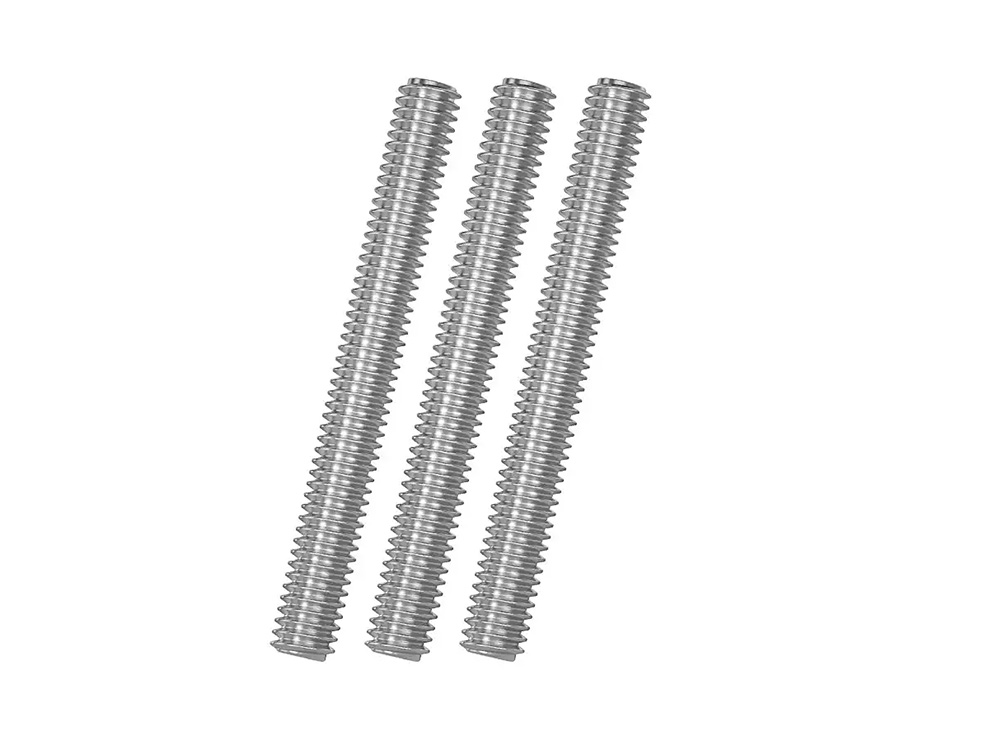

No, brass does not rust. Brass is rust resistant because it contains no iron, and rust is a form of iron oxide that only develops when iron or steel reacts with oxygen and moisture. Since brass is an alloy made primarily of copper and zinc, it cannot produce traditional rust like carbon steel.
However, brass is not completely corrosion-proof. Although brass does not rust, it can undergo other surface changes, including tarnishing, oxidation, and patina formation. These processes are different from rust. Brass tarnish usually appears as darkening, dulling, or a brownish surface layer, while outdoor brass may gradually develop a green patina caused by copper compounds reacting with moisture and carbon dioxide.
The key difference is that rust weakens iron-based metals by continuously damaging the underlying material, while brass tarnish is typically a surface-level reaction that does not indicate structural failure. This is why brass fittings, hardware, and decorative components can remain functional for decades even after their appearance changes.
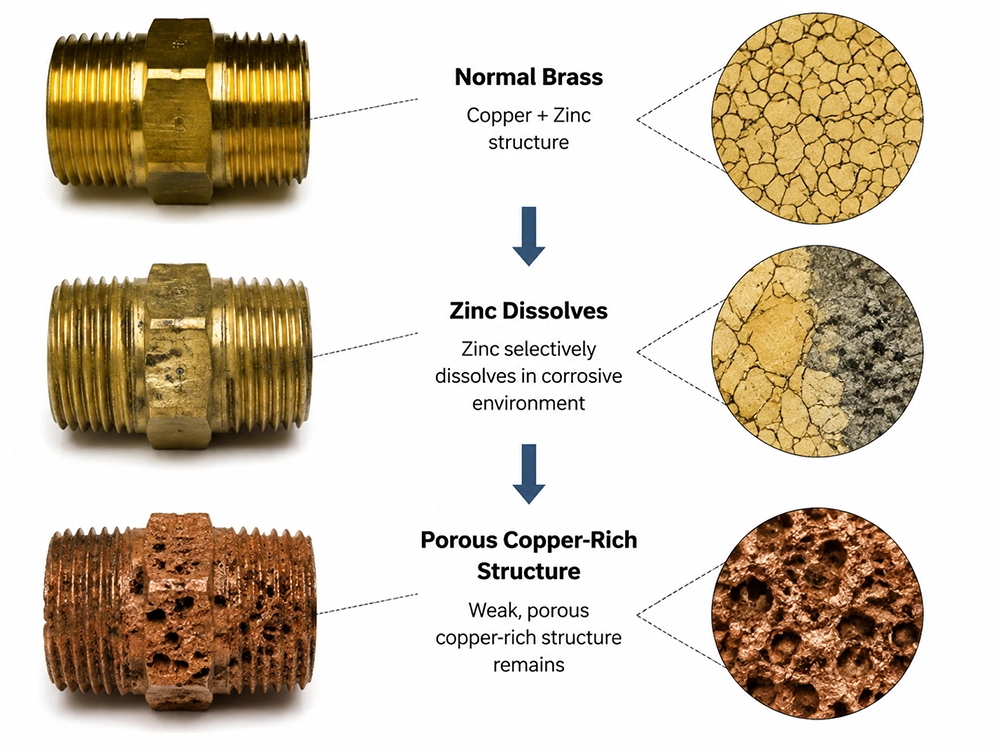
However, under certain conditions, brass can experience a specific corrosion problem called dezincification. In aggressive water environments, especially those involving high chloride levels or unsuitable brass alloys, zinc may selectively dissolve from the material, leaving behind a weakened copper-rich structure.
Therefore, the correct answer to “Is brass rust resistant?” is: Yes, brass is naturally resistant to rust because it contains no iron, but it can still corrode through processes such as tarnishing and dezincification depending on the environment and alloy composition.
Many people use the words rust and tarnish interchangeably, but they describe two completely different metal aging processes. Understanding the difference is essential when evaluating brass corrosion resistance because brass does not rust in the same way as iron or steel.
Rust is a type of corrosion that occurs only on iron-containing metals. When iron or carbon steel is exposed to oxygen and moisture, it undergoes an electrochemical reaction that produces iron oxide, commonly known as rust. This reddish-brown corrosion layer is porous and unstable, allowing water and oxygen to continue reaching the underlying metal. As a result, rust can gradually weaken the material and cause structural deterioration.
Brass does not rust because it contains no iron. Instead, brass experiences a surface reaction known as tarnishing. Since brass is primarily made of copper and zinc, the copper component can react with oxygen, sulfur compounds, moisture, or other environmental factors to form a thin surface layer. This may cause brass to become darker, duller, or develop a brownish appearance over time.
The key difference between rust and tarnish is their impact on the material. Rust typically represents progressive metal degradation, while brass tarnish is usually a surface-level change that does not significantly reduce the strength or function of the metal. A tarnished brass fitting, decorative item, or hardware component may look aged, but it can still remain durable and fully functional.
However, tarnish should not be confused with every type of brass corrosion. Under certain environmental conditions, brass can experience deeper corrosion problems such as dezincification, where zinc is selectively removed from the alloy. Unlike ordinary tarnishing, dezincification can affect the mechanical integrity of brass components.
In simple terms, brass does not rust; it tarnishes. Rust damages iron-based metals, while tarnish mainly changes the appearance of copper-based alloys. This distinction explains why brass can maintain long service life in many indoor and outdoor applications despite visible surface changes.
Although brass and copper share similar origins, their composition, durability, appearance, and applications are different. Read our complete brass vs copper guide to understand which material is better suited for different projects.
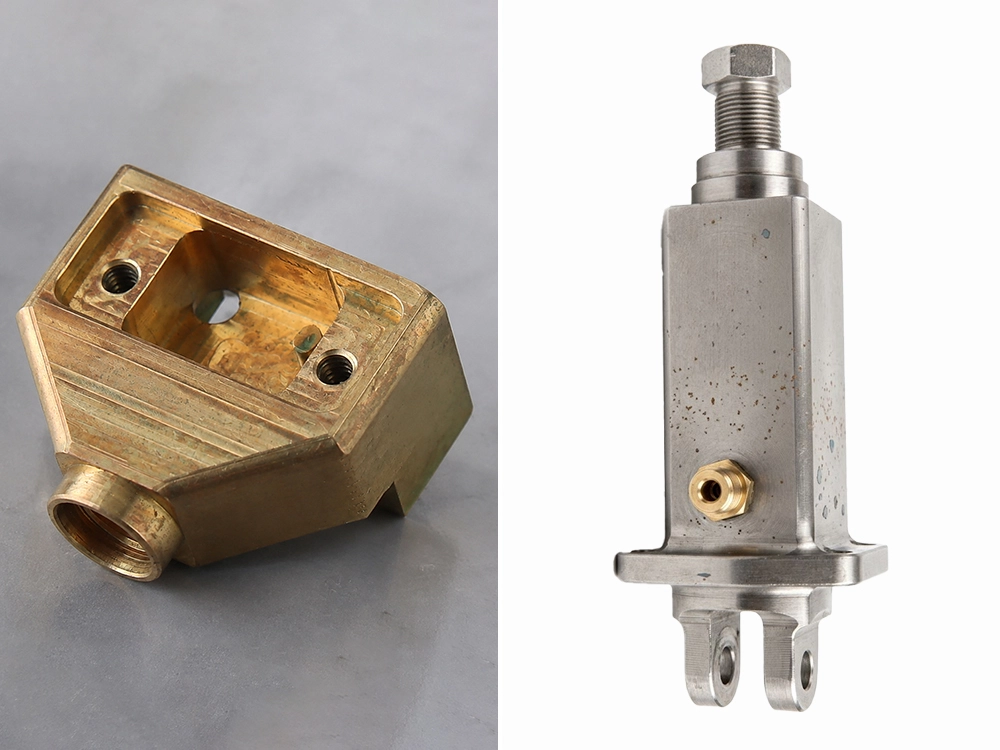
Although brass does not rust, its corrosion resistance comes from more than simply the absence of iron. The durability of brass is related to the chemical properties of its main elements, especially copper and zinc, as well as the protective surface reactions that occur when brass is exposed to the environment.
Copper provides the primary corrosion resistance of brass. When copper reacts with oxygen and moisture, it can form a thin and relatively stable oxide layer on the surface. Unlike iron rust, which tends to become loose, porous, and continuously expose fresh metal underneath, copper-based surface films can help slow further oxidation. This self-limiting reaction allows brass components to maintain their integrity over long periods of exposure.
The absence of iron is another fundamental reason why brass is rust resistant. Rust formation requires iron atoms to participate in oxidation reactions that produce iron oxides. Since brass is a copper-zinc alloy and contains no significant iron content, it cannot undergo the chemical process responsible for traditional rust formation. This is why brass fittings, hardware, and decorative components can remain functional even when exposed to air and moisture. Brass corrosion resistance is closely related to its composition. To understand why brass behaves differently from iron-based metals, it is helpful to first learn what brass is made of, including its copper-zinc composition, alloy types, and key properties.
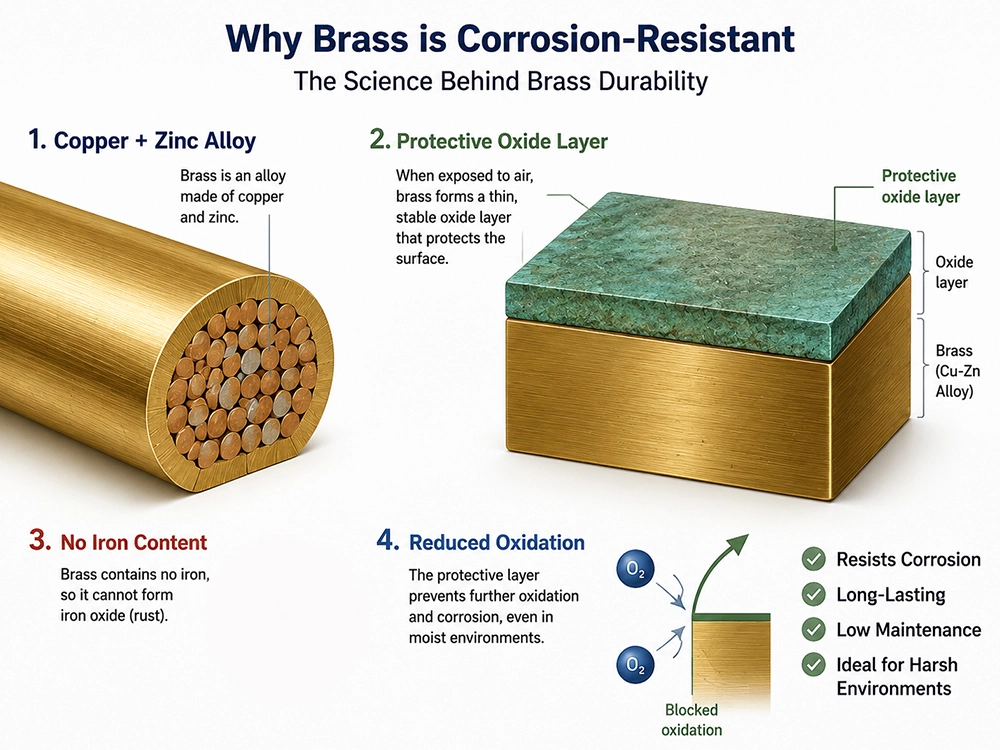
Zinc also influences the corrosion behavior of brass. In many brass alloys, zinc improves strength, hardness, and machinability. In certain environments, zinc can act as a preferentially reactive element, meaning it may corrode before copper. This behavior can provide some protective effects in mild conditions, but excessive zinc loss can also create a corrosion problem known as dezincification, which will be discussed in detail later.
The combination of copper’s natural corrosion resistance, the absence of iron, and carefully controlled alloy composition gives brass its excellent performance in many applications. This is why brass is widely used for plumbing fittings, door hardware, marine components, musical instruments, and architectural products where long service life and resistance to atmospheric exposure are required.
However, brass corrosion resistance is not identical for every alloy or environment. Factors such as zinc content, water chemistry, salt exposure, and temperature can significantly influence how well a specific brass component performs. Choosing the correct brass alloy is therefore essential when durability requirements are high.
Brass is widely used in plumbing components because it offers a good balance of corrosion resistance, strength, and machinability. If you are selecting materials for pipes, fittings, or valves, our guide on brass vs copper plumbing materials explains how these two copper-based metals compare in real applications.
Although brass does not rust, it can still experience a specific type of corrosion called dezincification. Unlike rust, which affects iron-based metals, dezincification is a selective corrosion process that occurs when zinc is removed from the brass alloy, leaving behind a weakened copper-rich structure.
Dezincification occurs when zinc atoms in brass dissolve into the surrounding environment faster than copper. Because brass is mainly composed of copper and zinc, the loss of zinc changes the internal structure of the alloy. Over time, the affected area may become porous, brittle, and less mechanically reliable.
Unlike surface tarnishing, dezincification is not just a cosmetic change. A brass component may appear normal on the outside while experiencing internal material degradation. In applications such as plumbing fittings, valves, and water-contact components, this can eventually lead to reduced strength, leakage, or premature failure.
This is why the question “Does brass corrode in water?” requires a more detailed answer. Brass generally performs well in water environments, but certain combinations of alloy composition and water chemistry can create conditions where dezincification becomes possible.
Dezincification is most commonly associated with high-zinc brass alloys exposed to aggressive water conditions. Environments that increase the risk include:
Soft water with low mineral content
Low-pH acidic water
High chloride environments
Warm water systems
Marine or coastal exposure
In particular, plumbing systems and marine components can face higher risks because they often experience continuous moisture exposure and chemically active environments.
The type of brass alloy also plays an important role. Brass with higher zinc content is generally more susceptible because there is more zinc available for selective dissolution. For this reason, standard decorative brass may not be suitable for every water-contact or marine application.
The risk of dezincification can be reduced through proper material selection and alloy design. Manufacturers often use dezincification-resistant brass (DZR brass) for plumbing and drinking water applications. DZR brass contains alloying adjustments that improve resistance against zinc loss while maintaining the useful properties of brass.
Other prevention strategies include:
Selecting low-zinc or corrosion-resistant brass alloys
Matching the brass grade to the operating environment
Avoiding unsuitable combinations of alloy and water chemistry
Using marine-grade brass for saltwater applications
Therefore, while brass is naturally resistant to rust, its long-term corrosion performance depends on choosing the right alloy for the specific environment. Understanding dezincification helps explain why some brass products last for decades, while others may fail under harsh conditions.
When choosing a metal for hardware, plumbing, outdoor components, or industrial applications, one of the most common comparisons is brass vs. stainless steel corrosion resistance. Both materials perform much better than ordinary carbon steel, but they resist environmental damage in different ways.
The answer to “Does brass rust faster than stainless steel?” is more complicated than a simple yes or no. Neither brass nor stainless steel rusts in the traditional sense. Brass does not rust because it contains no iron, while stainless steel resists rust through a thin chromium oxide layer that protects the surface from further oxidation.
However, their performance can differ depending on the environment. In mild indoor conditions, both brass and stainless steel can provide decades of service with minimal maintenance. In more aggressive environments, such as marine areas, saltwater exposure, or chemical processing environments, stainless steel—especially marine-grade 316 stainless steel—generally provides stronger corrosion resistance.
| Factor | Brass | Stainless Steel |
|---|---|---|
| Rust resistance | Does not rust because it contains no iron | Resists rust through chromium oxide protective layer |
| Corrosion resistance in harsh environments | Good, but some alloys may experience dezincification | Excellent, especially 316 stainless steel |
| Strength and hardness | Lower strength but excellent machinability | Higher strength and mechanical durability |
| Appearance | Develops natural tarnish or patina over time | Maintains metallic appearance with proper maintenance |
| Common applications | Plumbing fittings, decorative hardware, instruments | Marine equipment, structural parts, industrial components |
Technically, brass does not rust faster than stainless steel because brass cannot rust at all. The more accurate comparison is how each material responds to corrosion.
Brass relies mainly on its copper content and alloy structure to resist environmental attack. It performs well in indoor environments, general outdoor hardware, and many plumbing applications. However, certain brass alloys exposed to aggressive water conditions may experience dezincification.
Stainless steel, on the other hand, relies on chromium to create a passive oxide layer. This protective film can repair itself when damaged, allowing stainless steel to maintain strong corrosion resistance in demanding environments. This is why stainless steel is often preferred for marine applications, food-processing equipment, and industrial systems.
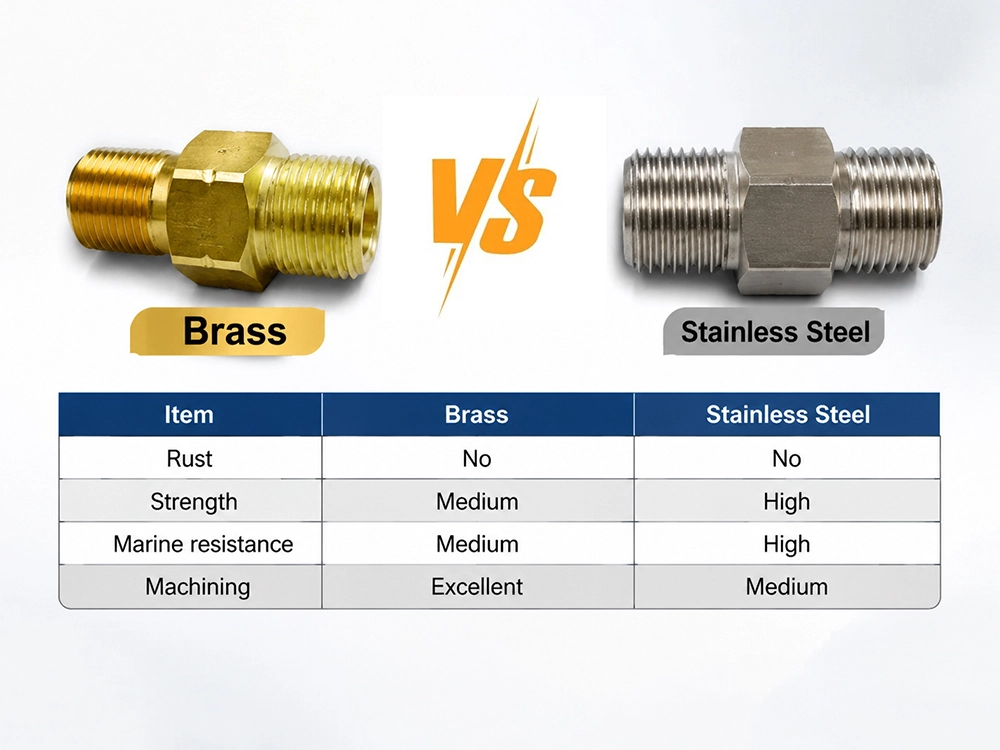
No. Stainless steel generally has higher strength, hardness, and mechanical durability than brass. Brass is a softer alloy, but it offers advantages in other areas, especially machinability, electrical conductivity, and appearance.
Because brass is easier to machine and shape, it is widely used for precision fittings, valves, connectors, and decorative components. Stainless steel is more commonly selected when the material must withstand heavy loads, impact, high pressure, or severe operating conditions.
Therefore, material selection depends on the purpose:
Choose brass when appearance, machinability, corrosion resistance, and ease of manufacturing are priorities.
Choose stainless steel when maximum strength and harsh-environment durability are required.
The answer depends on the environment and the specific alloy.
For indoor hardware, decorative applications, and normal outdoor exposure, both brass and stainless steel can last for many years. Brass may gradually develop tarnish or patina, but this usually affects appearance rather than function.
For coastal, marine, or chemically aggressive environments, stainless steel—particularly 316 stainless steel—usually provides longer-lasting corrosion protection. However, specialized brass alloys such as naval brass (C464) can also perform well in marine conditions because of improved resistance to chloride-related corrosion.
Overall, brass offers excellent rust resistance, attractive appearance, and easy processing, while stainless steel provides superior strength and extreme-environment corrosion resistance. The better choice depends on whether the priority is aesthetics and workability or maximum durability under harsh conditions.
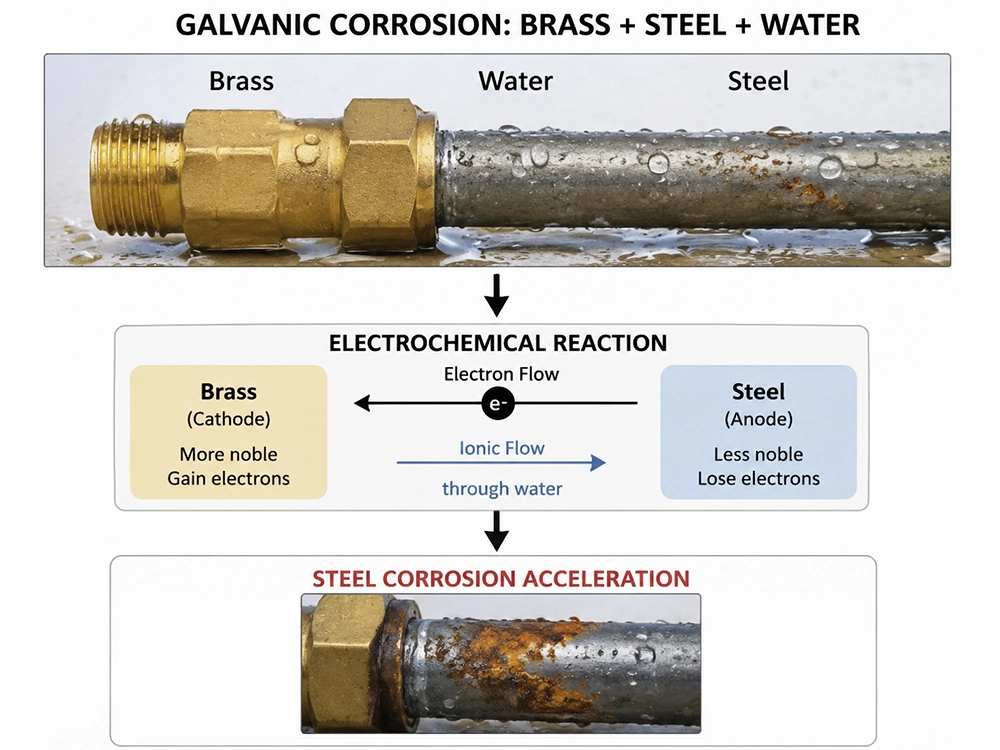
Although brass itself does not rust, combining brass with other metals can create a different corrosion concern called galvanic corrosion. This is especially important in plumbing systems, outdoor hardware, fasteners, and metal assemblies where different materials are connected and exposed to moisture.
Galvanic corrosion occurs when two different metals with different electrochemical potentials are in direct contact while an electrolyte, such as water or saltwater, is present. Under these conditions, one metal becomes the anode and corrodes more quickly, while the other metal acts as the cathode and is protected.
This means that a brass component may remain stable while accelerating corrosion of another connected metal. Therefore, the question “Can you mix steel and brass fittings?” depends not only on the materials themselves but also on the surrounding environment and whether proper isolation measures are used.
Galvanic corrosion is an electrochemical reaction between dissimilar metals that occurs when they are electrically connected in the presence of moisture.
Every metal has a different tendency to lose electrons. When two different metals touch each other, the less noble metal can become more chemically active and experience accelerated corrosion.
For example, when brass is directly connected to carbon steel in a wet environment, the steel component may corrode faster because of the difference in electrochemical potential between the two metals. The brass itself may appear unaffected, but the steel connection point can gradually weaken.
This process is different from ordinary corrosion because the problem is not caused by the metal reacting with the environment alone. Instead, it results from the interaction between two different materials.
Yes, brass and steel fittings can be used together, but direct contact should be avoided in moisture-exposed environments.
In dry indoor applications, brass and steel connections may perform adequately. However, in plumbing systems, outdoor installations, marine environments, or areas exposed to humidity, direct metal-to-metal contact can increase the risk of galvanic corrosion.
Common methods to reduce this risk include:
Using dielectric unions between brass and steel pipes
Installing insulating washers or sleeves
Applying protective coatings
Preventing long-term exposure to moisture
These isolation methods interrupt the electrical connection between the metals and reduce the possibility of accelerated corrosion.
Brass generally works well with copper and many stainless steel components because their electrochemical differences are relatively smaller. However, greater caution is needed when brass is connected directly to more reactive metals.
Potentially problematic combinations include:
Brass and carbon steel: steel may experience accelerated corrosion in wet environments.
Brass and galvanized steel: zinc coatings may be affected, reducing protection of the underlying steel.
Brass and aluminum: the large difference in electrochemical potential can increase corrosion risk.
For long-term outdoor or water-exposed installations, material compatibility should always be considered before combining different metals.
The practical rule is simple: brass does not rust, but brass connections can still contribute to corrosion problems when paired incorrectly with other metals. Proper material selection and electrical isolation are essential for maintaining the durability of mixed-metal systems.
One of the most common questions about brass is: “What is the green stuff on brass?” Many people assume that a green layer means the metal is rusting or deteriorating, but this is not the case. The green discoloration on brass is usually a natural patina formed by copper compounds, not rust.
Because brass is primarily made of copper and zinc, the copper component reacts slowly with environmental elements such as oxygen, moisture, carbon dioxide, and salts. Over time, these reactions can produce a green or blue-green surface layer known as patina or verdigris. This process is similar to the green surface that develops on copper structures, such as the Statue of Liberty.
Unlike iron rust, which continuously damages the underlying metal by creating a loose and unstable oxide layer, brass patina is generally a surface reaction. In many cases, this protective layer can actually reduce further exposure of the underlying metal to the environment.
The green layer on brass is called patina, and it is mainly composed of copper-based compounds formed during natural oxidation.
When brass is exposed to outdoor conditions, especially humidity, rain, coastal air, or polluted environments, copper on the surface reacts with oxygen and carbon-containing compounds in the atmosphere. This gradually creates copper carbonate, copper chloride, and other copper-containing corrosion products that appear green.
The formation of patina is usually slow and depends on environmental conditions:
Indoor brass typically develops darker tarnish rather than green patina.
Outdoor brass exposed to moisture may gradually turn green.
Marine environments with salt exposure can accelerate surface changes.
Therefore, green brass does not necessarily mean damaged brass. In many architectural and decorative applications, the natural patina is considered part of the material’s appearance and aging process.
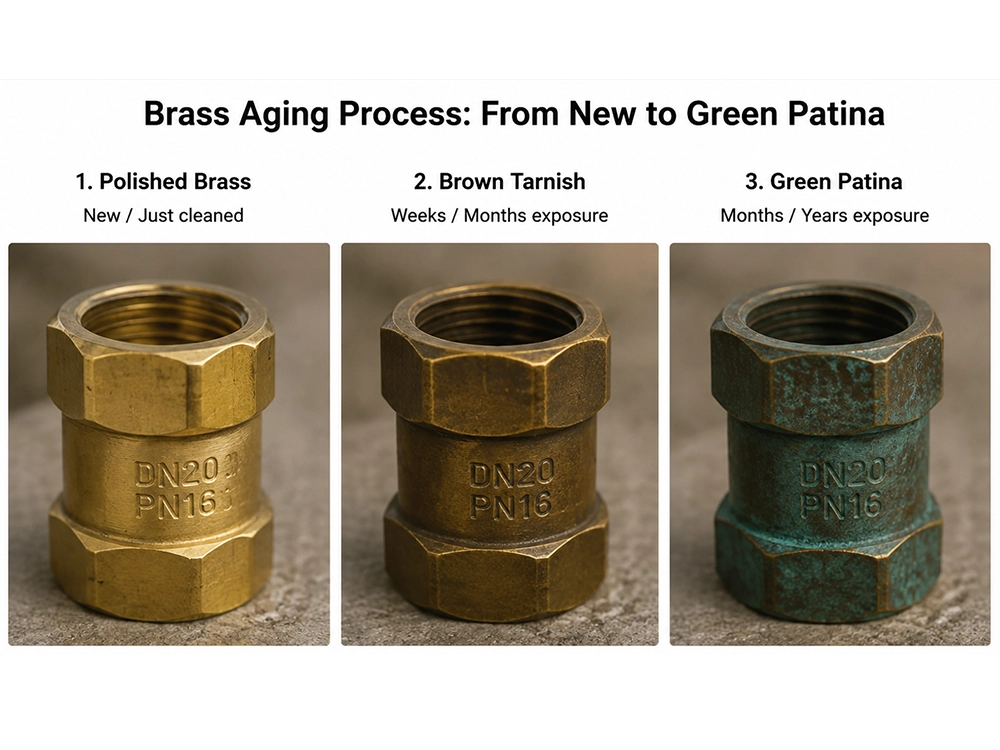
In most situations, green patina on brass is not a sign of structural failure. It mainly affects the appearance of the surface rather than the strength or function of the metal.
This is why many brass architectural elements, outdoor sculptures, and historical objects can remain stable for decades even after developing a green surface layer. The patina acts as a natural record of environmental exposure and is often valued for its aged appearance.
However, not all green corrosion products should be ignored. If brass components are used in sensitive applications such as plumbing, electrical connections, or mechanical systems, unusual corrosion patterns may indicate a more serious problem. For example, green discoloration combined with material weakening, leakage, or surface cracking may suggest underlying corrosion rather than simple patina formation.
The key distinction is:
Tarnish and patina: mainly surface-level appearance changes.
Dezincification or severe corrosion: processes that can affect the structure and performance of brass.
For outdoor applications, brass can naturally change color over time without losing its corrosion resistance. Whether the original polished gold appearance should be maintained or the natural patina should be preserved depends on the desired aesthetic and maintenance requirements.
The durability of brass depends not only on its natural corrosion resistance but also on where and how it is used. While brass does not rust, different environments can influence whether it only develops surface tarnish or experiences more serious corrosion processes. Choosing the correct brass alloy for the application is essential for achieving long-term performance.
For general indoor use and normal outdoor exposure, brass performs very well because its copper content provides natural resistance to atmospheric corrosion. However, environments involving saltwater, aggressive chemicals, or continuous water exposure require more careful alloy selection.
| Environment | Recommended Brass Type | Why It Performs Well |
|---|---|---|
| Indoor hardware and decorative applications | Standard brass | Low moisture exposure means tarnishing is mainly cosmetic |
| Outdoor hardware (non-marine) | Standard brass such as C260 or C360 | Handles normal atmospheric exposure with gradual surface aging |
| Marine and saltwater environments | Naval brass (C464) | Contains tin to improve resistance against chloride-related corrosion |
| Drinking water and plumbing systems | Dezincification-resistant brass (DZR brass) | Designed to reduce zinc loss in water-contact applications |
| High-humidity environments | Lacquered or coated brass | Protective coatings slow tarnishing and preserve appearance |
| Industrial or chemical environments | Application-specific brass alloys | Chemical exposure can vary significantly depending on the environment |
For outdoor use, brass is generally a reliable material choice. Rain, humidity, and normal atmospheric exposure usually cause gradual tarnishing or patina formation rather than structural failure. This is why brass is commonly used in exterior lighting fixtures, architectural hardware, and decorative elements that require both durability and visual appeal.
However, marine environments are more demanding than ordinary outdoor conditions. Saltwater contains chloride ions that can accelerate corrosion reactions in many copper alloys. Standard brass may become vulnerable to dezincification under these conditions, so marine-grade alloys such as naval brass are often preferred.
For plumbing and water-contact applications, alloy selection is especially important. Although brass has been widely used for valves, fittings, and connectors, certain water chemistries can increase the risk of dezincification. DZR brass is specifically designed to improve resistance against this failure mechanism and is commonly selected for applications where long-term water exposure is expected.
The key point is that brass corrosion resistance is highly dependent on alloy composition and environmental conditions. A brass component that performs well indoors may not be the best choice for seawater, industrial chemicals, or aggressive water systems. Selecting the appropriate brass grade ensures that the material’s natural durability can be fully utilized.
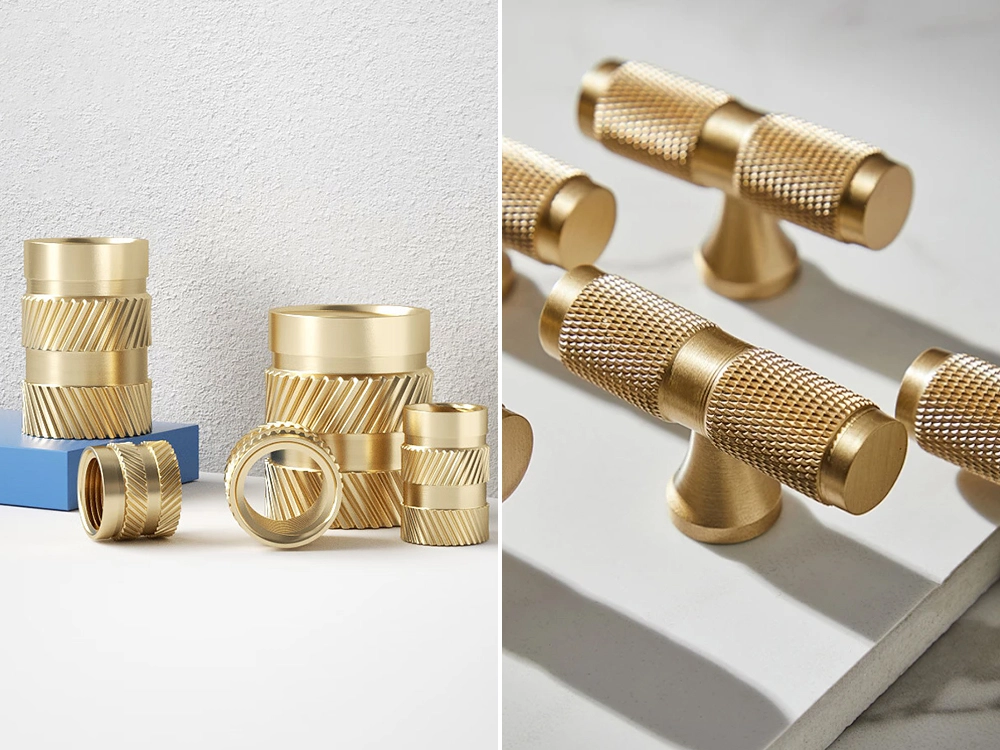
Although brass does not rust, its surface can gradually lose its original shine through tarnishing. Tarnish is a natural reaction between the copper in brass and environmental factors such as oxygen, moisture, sulfur compounds, and pollutants. Unlike rust on iron, brass tarnish is usually a surface-level change and can often be slowed, removed, or prevented with proper maintenance.
The best way to protect brass depends on whether the goal is to maintain its original polished appearance or preserve its natural aged patina. Decorative brass items, architectural hardware, and frequently handled components may require more regular care, while outdoor brass products may intentionally be allowed to develop a natural surface layer.
Regular cleaning
Routine cleaning is one of the simplest ways to reduce brass tarnishing. Dust, fingerprints, moisture, and airborne contaminants can accelerate surface oxidation. Cleaning brass with mild soap and warm water helps remove these substances without damaging the metal surface.
For heavier tarnish, specialized brass cleaners or gentle polishing methods can restore brightness. However, excessive polishing should be avoided because repeated removal of the surface layer may gradually alter the appearance of detailed or antique brass objects.
Protective coatings
A protective coating can significantly slow down brass oxidation by reducing direct contact between the metal surface and air or moisture. Clear lacquer, acrylic coatings, and other protective finishes are commonly used for decorative brass applications where maintaining the original golden color is important.
Coated brass requires less frequent polishing because the protective layer acts as a barrier against environmental exposure. However, damaged coatings should be repaired because scratches or worn areas can allow localized tarnishing to develop.
Wax-based protection
Wax coatings provide another option for brass items that are frequently touched, such as door handles, fixtures, and decorative objects. Unlike permanent coatings, wax creates a renewable protective barrier that can be reapplied periodically.
This method is useful when users want to slow tarnishing while maintaining the natural appearance and texture of brass.
Reduce prolonged moisture exposure
Because moisture accelerates surface reactions, keeping brass dry can extend the time before tarnishing appears. After exposure to water, especially in outdoor or marine environments, drying the surface can reduce oxidation rates.
For brass components used in humid environments, proper ventilation and moisture control can also improve long-term appearance and durability.
Control the environment
Brass stored indoors in stable conditions typically tarnishes much more slowly than brass exposed to outdoor weather, salt spray, or industrial pollutants. Reducing humidity and limiting exposure to aggressive chemicals can significantly extend the maintenance cycle.
Overall, preventing brass tarnish is mainly about controlling surface exposure rather than preventing corrosion damage. Since brass naturally resists rust, maintenance focuses on preserving appearance, slowing oxidation, and keeping the material in its desired condition.
When comparing metals for durability, corrosion resistance, and outdoor performance, brass, copper, and steel behave very differently. Although brass and copper do not rust like iron-based metals, carbon steel is highly vulnerable to rust unless it is protected with coatings or surface treatments.
Understanding the difference between these metals helps explain why brass is considered rust resistant, why copper develops a protective patina, and why steel requires additional protection in many environments.
| Metal | Does It Rust? | Corrosion Behavior | Typical Durability |
|---|---|---|---|
| Carbon steel | Yes | Forms iron oxide rust that can continue damaging the underlying metal | Requires coatings or maintenance in outdoor environments |
| Copper | No | Forms a stable patina that can protect the surface from further corrosion | Often lasts for decades outdoors |
| Brass | No | Develops tarnish or patina; some alloys may experience dezincification | Long service life when the correct alloy is selected |
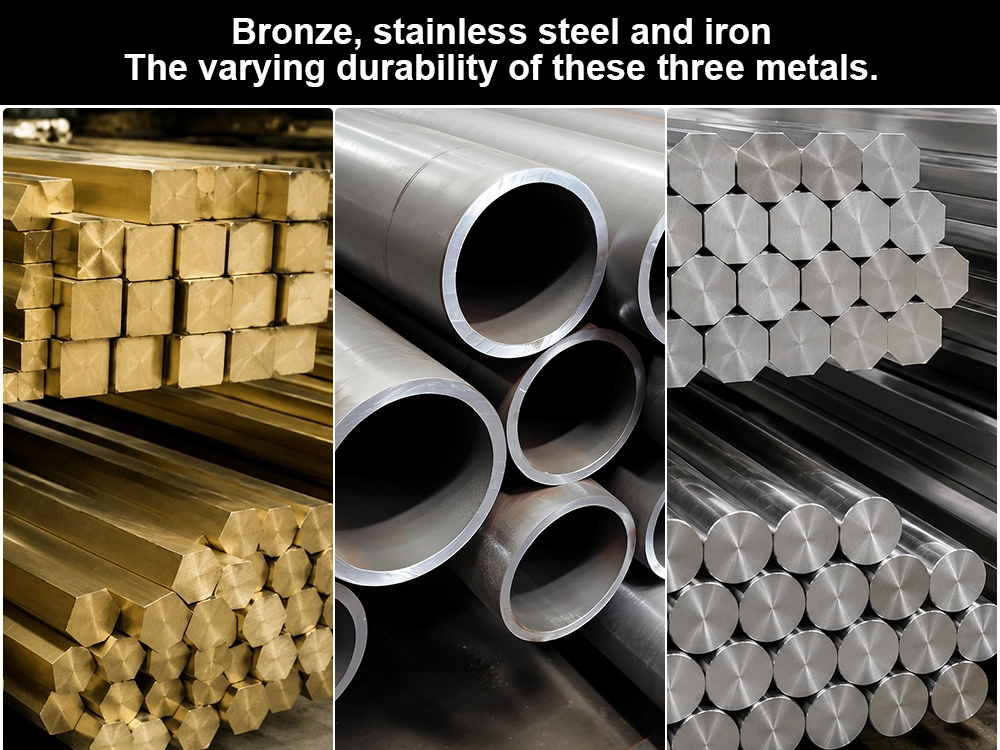
Brass vs. Steel: Why Brass Resists Rust Better
The biggest difference between brass and carbon steel is their chemical composition.
Steel contains iron, which allows rust formation. When carbon steel is exposed to oxygen and moisture, iron atoms react to form iron oxide. Because rust is porous and does not effectively protect the underlying metal, corrosion can continue deeper into the material.
Brass contains copper and zinc but little to no iron, so it cannot form traditional rust. Instead, brass develops surface oxidation products that usually progress much more slowly and are often mainly cosmetic.
This is why untreated carbon steel may deteriorate quickly in outdoor environments, while brass hardware can remain functional for many years even when exposed to weather conditions.
Brass vs. Copper: Similar Protection Mechanisms
Brass and copper share similar corrosion behavior because copper is the primary element responsible for their surface protection.
Copper naturally develops a green patina over time when exposed to moisture and air. Brass can also develop similar copper-based surface compounds because it contains a significant amount of copper.
However, brass has different mechanical properties because the addition of zinc changes its hardness, strength, and manufacturing characteristics. Compared with pure copper, brass is often easier to machine and is widely used for fittings, valves, connectors, and precision components.
Which Metal Is Best for Corrosion Resistance?
There is no single metal that performs best in every environment.
Carbon steel offers high strength but requires protection against rust.
Copper provides excellent natural corrosion resistance and develops a protective patina.
Brass combines copper’s corrosion resistance with improved machinability and attractive appearance.
Stainless steel generally performs best in highly aggressive environments because of its chromium-based protective layer.
For everyday applications, brass provides an excellent balance between durability, appearance, and corrosion resistance. For extreme environments such as seawater exposure or heavy industrial conditions, specialized materials such as marine-grade stainless steel or naval brass may be more appropriate.
The key factor is not simply whether a metal can rust, but how that metal responds to its environment and whether the selected alloy matches the application requirements.
No, brass does not rust like iron or steel because it contains no iron. Rust is specifically the iron oxide corrosion that occurs on ferrous metals. Brass is a copper-zinc alloy that can tarnish, oxidize, or develop a natural patina when exposed to air, moisture, or chemicals. These surface changes do not mean the brass is failing; in many cases, the patina helps protect the underlying metal.
Brass does not rust because rust requires iron, and brass is mainly made of copper and zinc. Instead of forming red iron oxide, brass reacts with oxygen and environmental elements to create copper oxides, zinc oxides, and other corrosion products. This process may darken the surface or create a green patina, but it is different from rust and usually develops much more slowly than rust on steel.
Brass tarnishes rather than rusts. Tarnish is a thin surface layer caused by oxidation, which can make brass appear darker, dull, or slightly green over time. Unlike rust on iron, brass tarnish usually affects only the surface and can often be removed through polishing or cleaning. Many architectural and decorative applications choose brass because its natural aging creates a unique patina.
No. Brass does not rust, while stainless steel is also highly resistant to rust because of its chromium oxide protective layer. In harsh environments, especially saltwater or chemical exposure, stainless steel generally provides better corrosion resistance than standard brass. However, brass offers excellent durability, machinability, and a distinctive appearance, making it widely used for hardware, fittings, and decorative applications.
The lifespan of brass and stainless steel depends on the environment and application. Stainless steel usually lasts longer in extreme conditions because of its superior corrosion resistance. Brass, however, can last for decades when properly maintained and is often preferred for architectural hardware because it develops an attractive patina while maintaining structural strength.
Yes, brass can corrode in saltwater because chloride ions can attack copper-zinc alloys over time. One possible issue is dezincification, where zinc is selectively removed from the alloy, weakening the material. For marine environments, specialized marine brass alloys, protective coatings, and proper maintenance are recommended to improve long-term performance.
Yes, brass has good corrosion resistance compared with many common metals, especially in indoor and architectural applications. Copper in brass provides natural corrosion resistance, while zinc improves strength and machinability. However, brass is not completely corrosion-proof and may require protective coatings or specific alloy selection for outdoor, marine, or industrial environments.
The best way to prevent brass tarnishing is to reduce exposure to moisture, chemicals, and air pollutants. Regular cleaning with a soft cloth, applying a protective wax or clear coating, and keeping brass surfaces dry can significantly slow oxidation. For polished brass hardware, lacquer or professional protective finishes can help maintain a bright appearance for longer periods.
Clear lacquer, protective wax coatings, and advanced finishes such as PVD coatings are commonly used to keep polished brass shiny. Clear lacquer provides a transparent barrier against oxygen and moisture, while PVD coatings offer higher durability and scratch resistance. The best choice depends on whether the goal is long-term shine retention or allowing brass to naturally develop a patina.
Yes, both brass and copper can corrode, but they do not rust like iron-based metals. Copper develops a protective green patina over time, while brass may darken or form surface oxidation depending on its zinc content and environment. These corrosion processes are generally slower and less damaging than rust on steel, which is why copper alloys are widely used in plumbing, hardware, and marine applications.
Stop thinking more, fill out the blank below, and send us an inquiry, and you will have a professional team of board game custom products contact you to answer any questions and provide pricing.
You can send us any questions to get any information you would like to know, and we will respond to you in extremely short time.