

Two of the most common materials in precision manufacturing — here’s how they actually compare, and when each one wins.
If you only have ten seconds: copper conducts electricity and heat far better, but brass machines faster, costs less, and holds a sharper edge under load. Everything below explains why — and when each material is the right call for your part.
| Property | Brass | Copper |
|---|---|---|
| Composition | Copper-zinc alloy (typically 60–70% Cu, 30–40% Zn) | Pure copper (99%+ Cu) |
| Electrical conductivity | ~25–28% IACS | ~95–100% IACS |
| Thermal conductivity | ~110–125 W/(m·K) | ~385–400 W/(m·K) |
| Hardness (Brinell) | Higher — 55–155 HB depending on grade | Lower — 35–65 HB (soft, annealed) |
| Tensile strength | 170–450 MPa | 70–300 MPa |
| Machinability | Excellent (C360 is the free-machining benchmark) | Fair to good — tends to gall and produce stringy chips |
| Corrosion resistance | Good; some alloys prone to dezincification | Excellent; resists most atmospheric and aqueous corrosion |
| Typical cost | Generally lower | Generally higher |
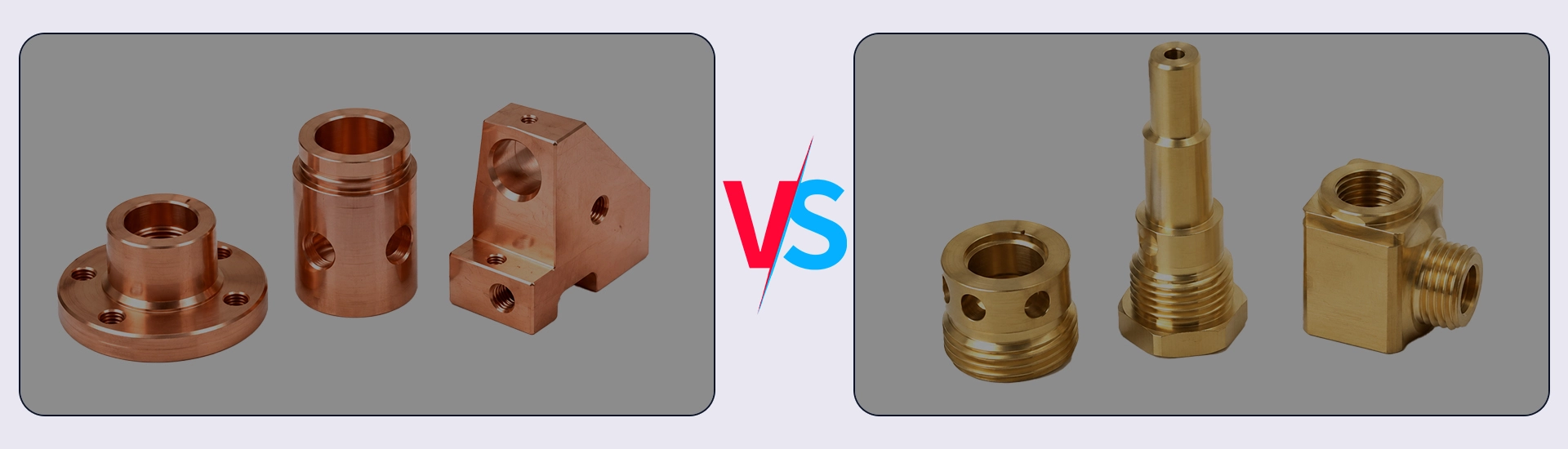
| Color | Yellow-gold | Reddish-orange |
This table answers the most common version of the question — what’s actually different between the two — at a glance. The sections below go deeper into each row, because “it depends on your application” is really the honest answer to most of these comparisons.
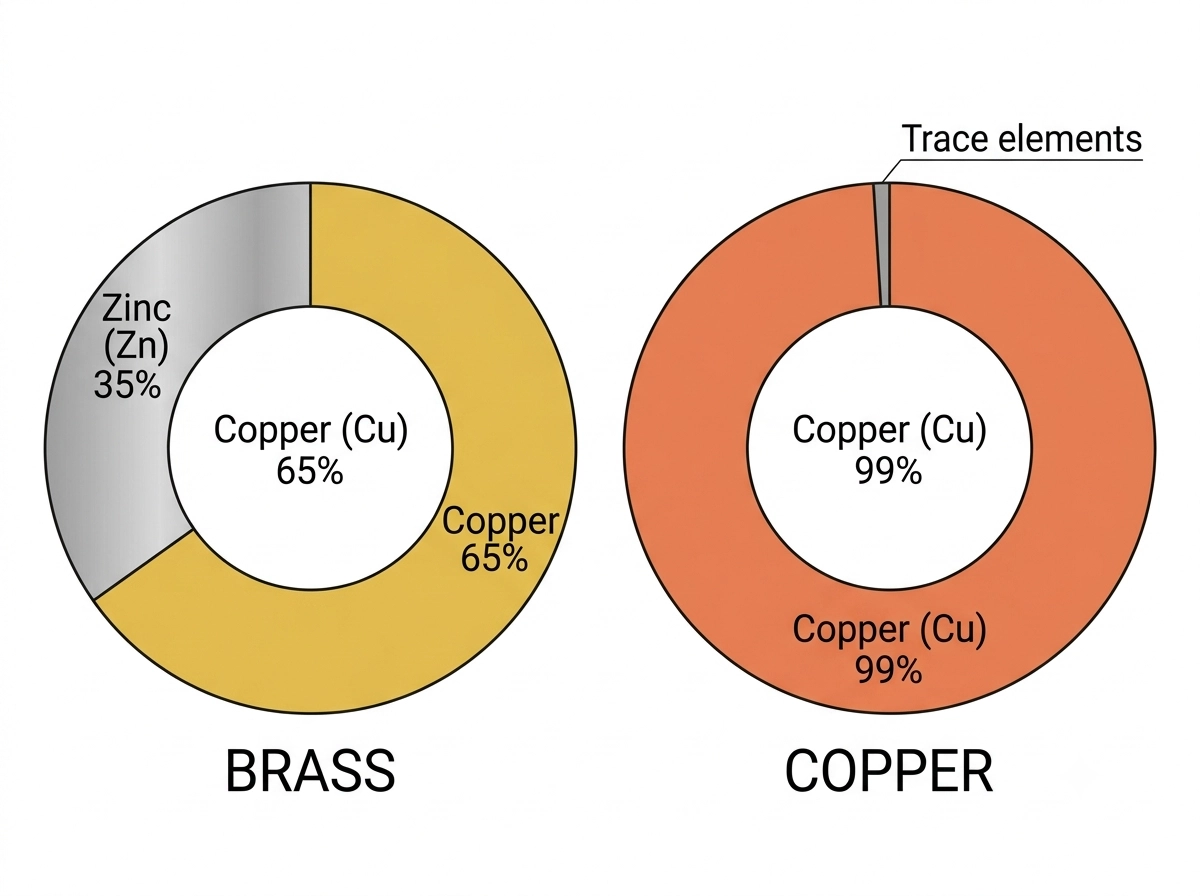
Yes — brass is not a separate base metal. It’s an alloy made primarily of copper, with zinc added to change its properties. Most commercial brass alloys run somewhere between 60% and 70% copper, with the remainder mostly zinc and small amounts of other elements like lead (for machinability) or tin (for corrosion resistance).
Copper, by contrast, is used in its near-pure form for machined parts — typically 99% or higher purity, depending on the grade (more on grades below).
So when someone asks “is brass copper” or “is brass a copper alloy,” the answer is: brass contains copper as its majority component, but it is a distinct engineered material with mechanical and electrical properties quite different from pure copper. Adding zinc is what gives brass its gold color, improves its machinability, and — as you’ll see in the next section — significantly reduces its conductivity.
→ For a closer look at the different brass alloy grades and how their copper-zinc ratios affect color, strength, and price, see our full guide: What is brass made of? Composition, alloys & properties explained.
This is where the two materials diverge the most, and it's the single biggest factor in choosing between them for electrical or thermal applications.
Electrical conductivity. Pure copper typically rates at 95–100% IACS (International Annealed Copper Standard — the reference scale conductivity is measured against). Brass conducts electricity too, since it's copper-based, but the zinc content interrupts the copper's crystal lattice and drags conductivity down to roughly 25–28% IACS for common alloys. In practical terms, copper conducts electricity about three to four times better than brass.
Thermal conductivity. The pattern repeats for heat transfer. Copper sits at approximately 385–400 W/(m·K), among the highest of any engineering metal. Brass trails at roughly 110–125 W/(m·K) — still respectable, but copper will pull heat away from a hot component noticeably faster.
What this means practically
If your part is a busbar, an electrical terminal, a heat sink, or anything where current-carrying capacity or heat dissipation is the actual job of the part, copper is almost always the better-performing choice. Brass conducts "well enough" for many lower-current applications, but it isn't competing with copper on this dimension — it's winning on others.
Brass is harder and generally stronger than copper in its common machined form. Pure copper is a soft, ductile metal — it’s prized for conductivity precisely because its crystal structure allows electrons (and heat) to move freely, but that same structure makes it deform more easily under mechanical load.
Typical numbers:
This is why brass is the default choice for fittings, valve bodies, gears, and hardware that needs to resist wear and deformation, while copper is reserved for parts where conductivity outweighs the need for mechanical robustness — and where the part isn’t subject to heavy structural load.
→ For a closer look at copper’s mechanical and engineering properties across different alloy grades, see our copper material properties & engineering applications guide.
From a manufacturing standpoint, this is often the deciding factor — and it's one we deal with daily on the shop floor.
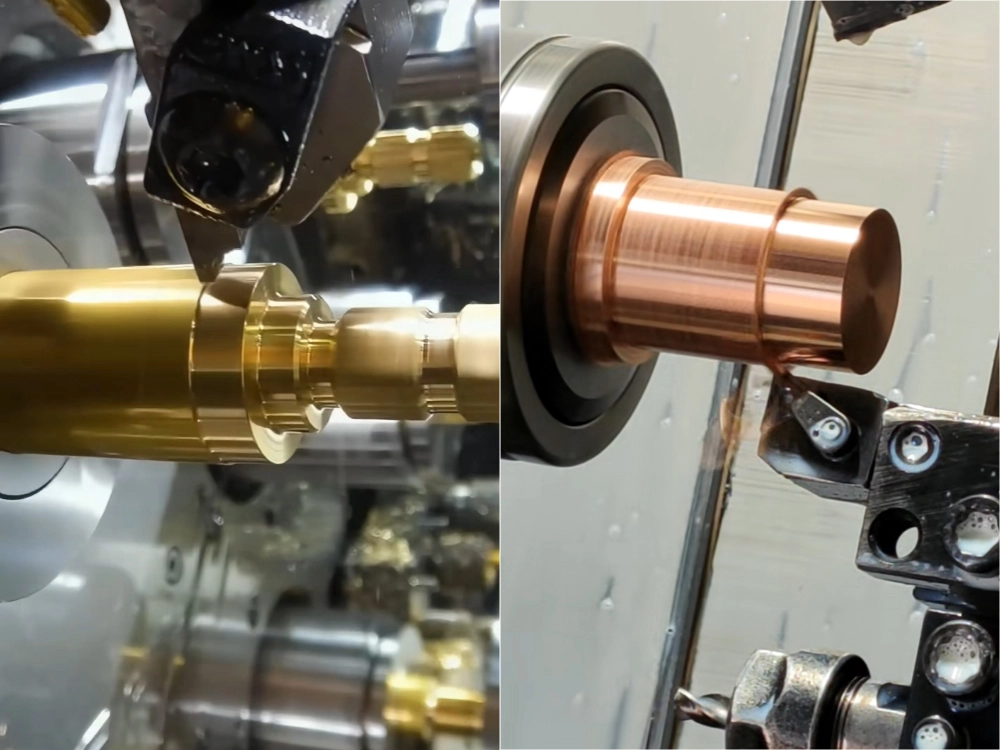
5-axis milling of brass heatsink base plate — high-speed spindle cuts cleanly through the alloy with minimal tool wear.
Machinability benchmark
C360 free-machining brass is the industry standard — a rating of 100% on the machinability scale. Everything else is measured against it.
Swiss-type CNC lathe machining small-diameter copper pins — requiring specialized tooling and chip management to prevent galling and produce clean surfaces.
Worth the effort
We machine copper daily. It's slower and more demanding than brass, but when your part needs conductivity or heat transfer, copper is the only choice — the machining cost is justified by performance.
| Parameter | Brass (C360) | Copper (C110) |
|---|---|---|
| Turning Cutting Speed (Vc) | 180 – 350 m/min | 90 – 180 m/min |
| Milling Feed per Tooth (fz) | 0.08 – 0.25 mm/z | 0.03 – 0.10 mm/z |
| Recommended Tool Material/Coating | Carbide (uncoated) or TiN-coated | Ultra-fine grain carbide / DLC-coated or PCD |
| Average Tool Life | ~1,200 – 1,500 parts | ~300 – 500 parts |
| Typical Surface Roughness (Ra) | 0.8 – 1.6 μm | 1.6 – 3.2 μm (finishing can reach 0.4 – 0.8 μm) |
Figures above are typical process values based on standard carbide tooling and common machining scenarios such as valve component turning. Brass (C36000) offers excellent machinability, while copper (C11000) is prone to built-up edge and requires reduced cutting speed and lower feed rates to avoid chip welding. Actual parameters should be fine-tuned based on machine rigidity, coolant conditions, and tooling manufacturer recommendations.
Brass's roughly 2× higher cutting speed and longer tool life (three to four times more parts per tool) are exactly why it consistently comes out ahead on cycle time — and why copper jobs tend to need closer in-process monitoring and more frequent tool changes.
In practice, this machining difference often shows up as a cost difference even before you account for raw material price: brass parts are frequently faster and cheaper to produce on a CNC machine, independent of the material cost itself. However, this should never be the only decision factor — if your part requires copper's conductivity or strength for thermal or electrical performance, the extra machining time is simply part of the engineering cost.
→ See our copper CNC machining services and brass CNC machining services for grade-specific capabilities.
Both metals perform well in everyday environments, but the details matter depending on what your part will be exposed to.
Copper has a long track record in plumbing and fluid systems — it forms a protective patina, resists most forms of atmospheric and aqueous corrosion, and doesn’t leach harmful compounds into potable water. This is why copper piping has been standard in residential plumbing for decades.
Brass generally resists corrosion well too, but certain alloys — particularly high-zinc brasses in contact with certain water chemistries — can be susceptible to a failure mode called dezincification, where zinc selectively leaches out of the alloy, leaving a weakened, porous structure behind. This is well understood in the industry and is typically addressed by specifying dezincification-resistant (DZR) brass grades for plumbing and marine applications.
For most general hardware, decorative, and indoor mechanical applications, this distinction rarely matters. It becomes relevant specifically for plumbing, marine, and other wet-environment parts — see our full breakdown in brass vs. copper plumbing: which material should you specify for pipes, fittings, and valves? for application-specific guidance.
If you’re holding two parts and need a quick answer, three simple checks usually settle it:
Color. Copper has a distinctive reddish-orange tone. Brass is yellow-gold, closer to the color of gold itself. Side by side, the difference is usually obvious — though aged or oxidized copper can darken toward brown, which sometimes causes confusion.
Magnetism. Neither metal is magnetic, so a magnet test won’t distinguish them directly — but it will tell you if you’re looking at a steel part with a brass or copper plating, which is a common point of confusion.
Sound. When tapped, brass tends to produce a brighter, more resonant ring, while copper sounds duller and more muted — a difference experienced machinists often notice before they even look closely at the color.
For a more detailed breakdown including edge cases like plated parts and aged patinas, see our full guide: how to tell the difference between brass and copper.
| If your part needs… | Choose |
|---|---|
| Maximum electrical conductivity (busbars, contacts, terminals) | Copper |
| Maximum thermal conductivity (heat sinks, cold plates) | Copper |
| Fast, economical CNC machining at volume | Brass |
| High hardness and wear resistance (gears, valve components) | Brass |
| Plumbing fittings and fluid-system hardware | Either — copper for tubing, DZR brass for fittings |
| Decorative hardware with a gold appearance | Brass |
| RF shielding or waveguide components | Copper |
| Lower per-part material and machining cost | Brass |
As a general rule: choose copper when the part’s job is to move electricity or heat, and choose brass when the part’s job is mechanical — structural, decorative, or fluid-handling — and conductivity isn’t the primary requirement.
Three quick examples of how this plays out in practice:
Plumbing valve body → Brass. A plumbing manufacturer needed precision-machined valve bodies with reliable threads, corrosion resistance, and a competitive unit cost at scale. Electrical conductivity wasn’t a requirement, so brass’s faster machining, better chip control, and longer tool life made it the clear choice.
High-current electrical connector → Copper. An industrial equipment maker needed a component for high-current transmission — low electrical resistance and long-term reliability were the deciding factors. Brass would have been easier to machine, but conductivity was non-negotiable here, so copper won despite the higher machining cost.
Decorative precision hardware → Brass. A manufacturer producing decorative mechanical components needed complex CNC machining, a consistent appearance, and high production volume. Brass delivered the machinability and cosmetic finish the part needed, with none of the compromises copper would have introduced.
The pattern across all three: the deciding factor was never the metal’s price — it was whether the part’s job actually required copper’s conductivity. If it did, copper was worth it. If it didn’t, brass won on cost, speed, and finish.
A quick decision framework, if you want to shortcut the analysis:
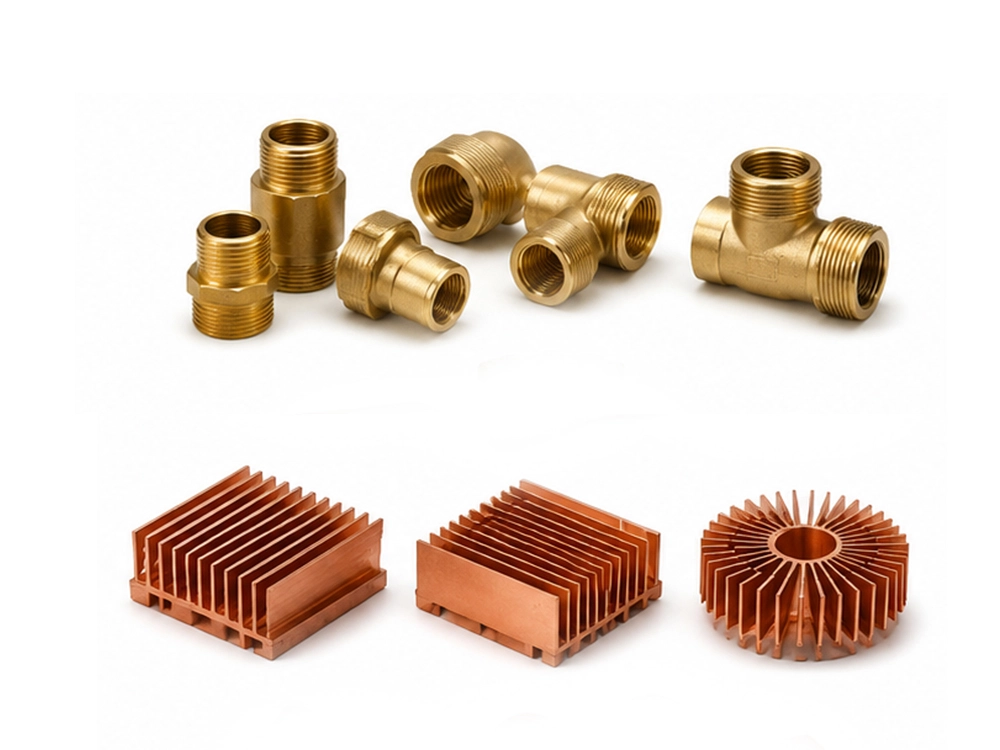
Generally, yes — brass tends to cost less than copper, for two compounding reasons. First, raw material pricing: copper is a globally traded commodity with a higher baseline price per kilogram than most brass alloys, since brass is “diluted” with lower-cost zinc. Second, as covered above, brass is typically faster and cheaper to machine, which compounds the raw material savings into a lower total part cost.
That said, exact pricing fluctuates with commodity markets, and the specific alloy and grade you choose matters more than the general copper-vs-brass comparison. A high-performance beryllium copper part, for instance, can cost more than many brass alternatives, while a basic red copper part may be closer in price to mid-grade brass.
We’d recommend getting a quote on your specific part and grade rather than relying on general commodity pricing — geometry, tolerance, and finish requirements often affect total cost more than the base material choice does.
To put these factors into concrete numbers, here’s a sample cost breakdown for a typical CNC-machined valve body:
Sample Cost Breakdown: Brass vs Copper Valve Body (Batch of 1,000 pcs)
| Cost Item | Brass (C360) | Copper (C110) |
|---|---|---|
| Material Price (USD/kg) | $8.50 | $12.50 |
| Material Cost per Part | $3.00 | $4.40 |
| Machining Time per Part | 2.5 min | 7.5 min |
| Machining Cost per Part | $2.50 | $7.50 |
| Tooling Cost Share | 3% | 10% |
| Total Cost per Part | $5.65 | $12.90 |
Figures above are typical CNC machining process estimates (assuming a raw blank weight of approximately 0.35 kg per valve body and a machine time rate of $60/hour), provided for cost-modeling reference only. Actual quotations depend on the specific part drawing, tolerance requirements, and current metal market prices.
Notice that the machining cost gap here (roughly 3×) is wider than the raw material cost gap (about 1.5×) — which is really the core point of this section: machining efficiency usually swings the total cost more than the sticker price of the metal does.
Is brass the same as copper?
No. Brass is a copper-zinc alloy, while copper (in machined parts) typically refers to a near-pure form of the metal. They share copper as a base but differ significantly in conductivity, hardness, and machinability.
Is brass conductive?
Yes, brass is electrically conductive — it’s copper-based — but at roughly 25–28% IACS, it conducts significantly less efficiently than pure copper (95–100% IACS).
Is brass harder than copper?
Yes. Brass is generally harder and stronger than pure copper, which is one of the softer common engineering metals in its annealed state.
Is brass cheaper than copper?
Generally yes, both in raw material cost and machining cost, though exact pricing depends on specific alloy grades and current commodity markets.
Does brass have copper in it?
Yes — copper is brass’s majority component, typically 60–70% of the alloy by weight, with zinc making up most of the remainder.
Is brass stronger than steel?
No. Most steel alloys have substantially higher tensile strength than brass. Brass is sometimes compared favorably to mild steel in specific properties like machinability and corrosion resistance, but not raw strength.
Is brass rust resistant?
Brass doesn’t rust in the traditional sense (rust specifically refers to iron oxide), and it resists general corrosion well. However, certain brass alloys can be susceptible to dezincification in some water conditions — see our corrosion resistance section above.
How can you tell the difference between copper and brass?
The fastest checks are color (copper is reddish-orange, brass is yellow-gold) and sound when tapped (brass rings brighter, copper sounds duller). See our full guide for additional methods.
Is copper heavier than steel?
Copper is denser than most carbon steels (about 8.9 g/cm³ vs. roughly 7.8–7.9 g/cm³ for steel), so a copper part will weigh more than an identically sized steel part.
What is brass an alloy of?
Brass is an alloy of copper and zinc, with the ratio of the two determining the specific alloy’s color, strength, and machinability characteristics.
How should I compare brass vs copper quotations from different suppliers?
Compare finished part cost, not just the metal price line item. Machining time and tool life typically matter more than raw material price for CNC parts — a quote with slightly higher material cost can still come out cheaper overall if it reflects faster, more efficient machining.
Stop thinking more, fill out the blank below, and send us an inquiry, and you will have a professional team of board game custom products contact you to answer any questions and provide pricing.
You can send us any questions to get any information you would like to know, and we will respond to you in extremely short time.