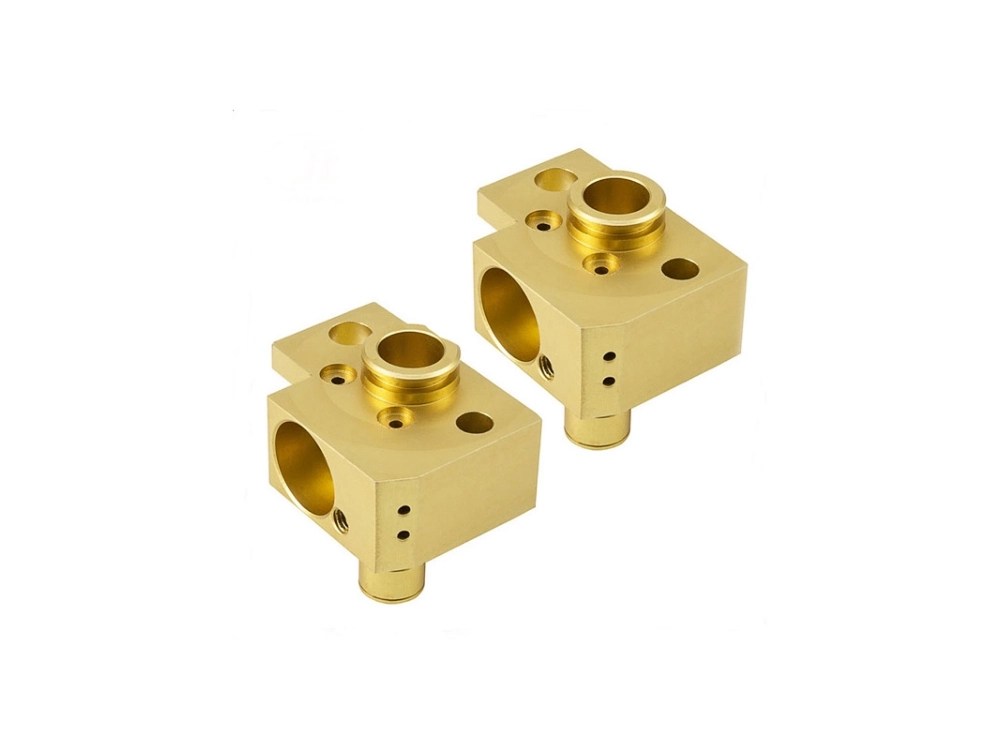

Choosing between brass and copper for a plumbing system is not simply a matter of material cost. The right choice depends on the component being manufactured, water quality, operating pressure, corrosion environment, machining requirements, and expected service life.
Although both materials contain copper, they are designed to solve different engineering challenges.
Copper has been the preferred material for water supply tubing for decades because of its excellent thermal conductivity, natural corrosion resistance, and long-term reliability. Brass, an alloy primarily composed of copper and zinc, offers superior strength, excellent machinability, and outstanding performance in threaded fittings, valves, connectors, and precision plumbing components.
Understanding where each material performs best allows engineers, OEM manufacturers, and procurement teams to optimize both product performance and total lifecycle cost.
This engineering guide compares brass and copper from the perspectives of plumbing design, manufacturing, corrosion resistance, maintenance, and CNC machining to help you specify the most suitable material for your next project.
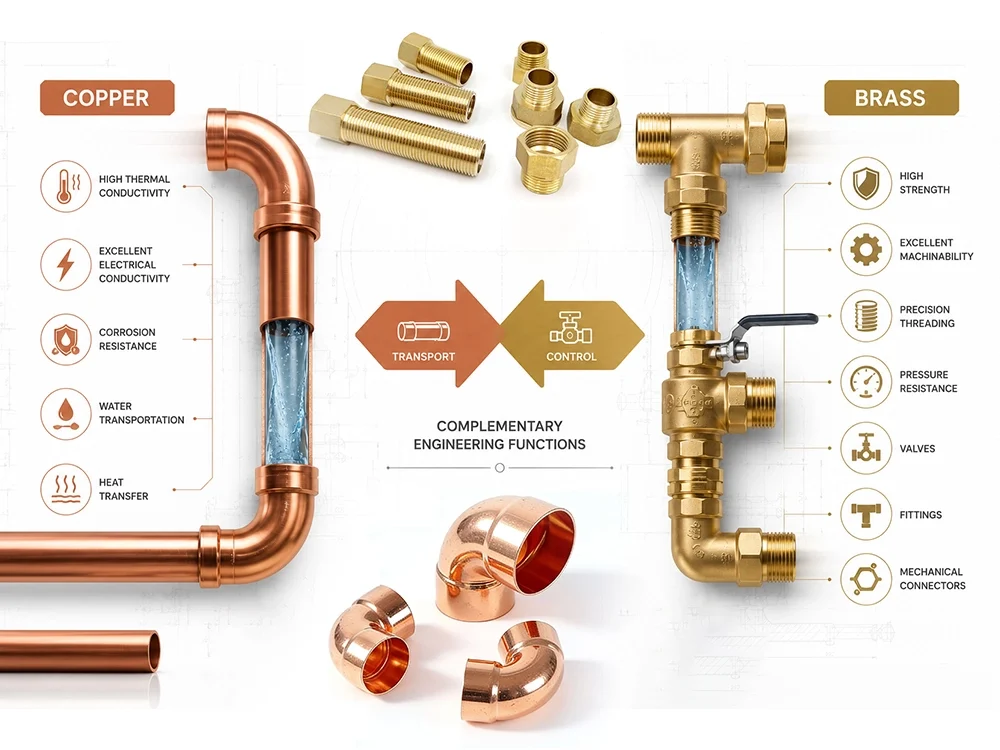
The answer depends on the application.
Copper is generally the preferred material for water supply pipes because it offers excellent corrosion resistance, high thermal conductivity, and proven long-term durability.
Brass is usually the better choice for plumbing fittings, threaded connectors, valve bodies, manifolds, and other precision-machined components because it provides higher mechanical strength, better wear resistance, easier machining, and lower manufacturing costs.
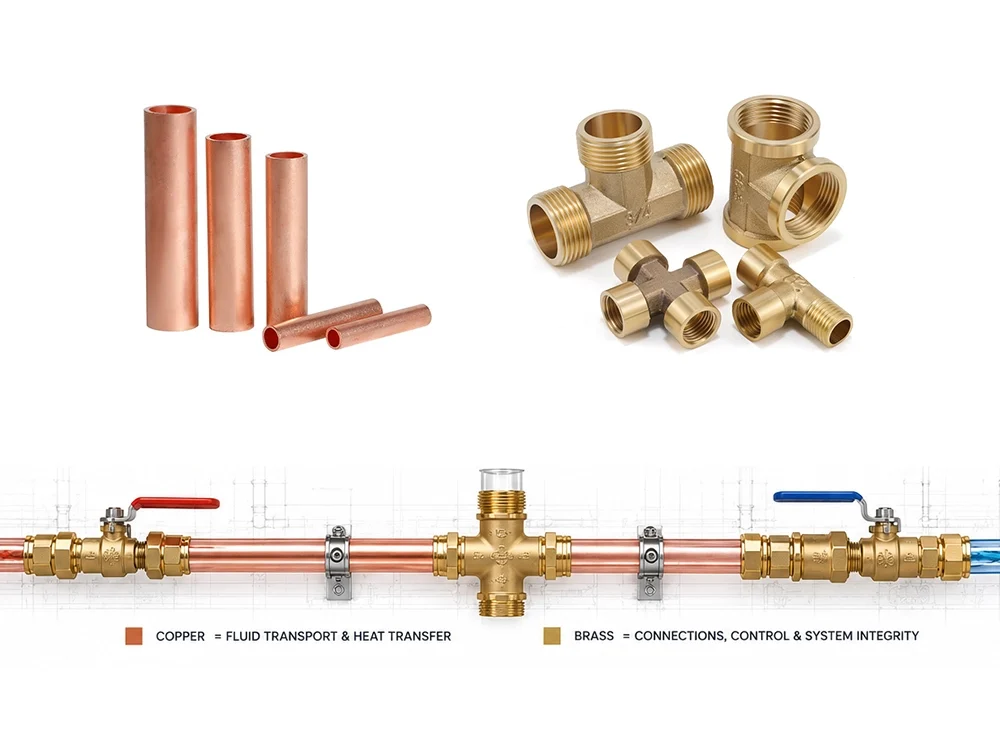
In modern plumbing systems, brass and copper are rarely competitors—they are complementary materials that work together. Copper typically transports water, while brass connects, controls, seals, and distributes the flow.
Quick Summary
| Application | Recommended Material | Primary Reason |
|---|---|---|
| Water Supply Pipes | Copper | Excellent corrosion resistance and thermal performance |
| Threaded Fittings | Brass | Superior strength and machinability |
| Ball Valves | Brass | High pressure resistance and dimensional stability |
| Compression Fittings | Brass | Better wear resistance and sealing performance |
| HVAC Water Systems | Copper + Brass | Optimized balance between conductivity and durability |
| Marine Plumbing | DZR Brass / Naval Brass | Improved resistance to aggressive water environments |
Key Takeaways
Selecting the right material is about matching engineering properties to the intended application—not choosing one material over another.
Although brass and copper share a similar base composition, their mechanical properties, machining characteristics, and long-term performance differ significantly. These differences determine where each material performs best within a plumbing system.
Rather than asking “Which material is better?”, engineers should ask:
“Which material performs better for this specific component under these operating conditions?”
The following comparison provides an engineering-based framework for selecting the most appropriate material.
| Property | Brass | Copper | Engineering Recommendation |
|---|---|---|---|
| Corrosion Resistance | Excellent | Excellent | Both perform well in potable water when the correct alloy is selected. |
| Mechanical Strength | Higher | Moderate | Brass is preferred for pressure-bearing components. |
| Machinability | Excellent | Moderate | Brass significantly reduces machining time and tooling wear. |
| Thermal Conductivity | Good | Excellent | Copper remains the preferred choice for heat transfer. |
| Electrical Conductivity | Moderate | Excellent | Copper is recommended for electrical applications. |
| Wear Resistance | Higher | Lower | Brass performs better in moving or threaded assemblies. |
| Thread Quality | Excellent | Moderate | Brass produces stronger and more consistent threads. |
| Dimensional Stability | Excellent | Good | Brass is preferred for precision-machined parts. |
| Material Cost | Generally Lower (depending on alloy and market conditions) | Generally Higher | Evaluate total lifecycle cost rather than raw material price alone. |
| Typical Plumbing Components | Valves, fittings, adapters, connectors | Pipes, tubing, heat exchangers | Most plumbing systems intentionally combine both materials. |
Different plumbing components are exposed to different mechanical loads, temperatures, pressures, and installation methods. Selecting materials based on component function improves both reliability and lifecycle performance.
| Plumbing Component | Recommended Material | Why |
|---|---|---|
| Water Supply Pipe | Copper | Excellent corrosion resistance and thermal conductivity |
| Threaded Pipe Fitting | Brass | Strong threads and easy precision machining |
| Ball Valve Body | Brass | High strength and pressure resistance |
| Compression Fitting | Brass | Better sealing performance and wear resistance |
| Heat Exchanger Tube | Copper | Superior heat transfer efficiency |
| Pump Connector | Brass | Better fatigue resistance under repeated tightening |
| Water Distribution Manifold | Brass | Excellent dimensional stability for complex machining |
| Refrigeration Tube | Copper | Industry-standard thermal performance |
| Instrument Adapter | Brass | Accurate machining and leak-free threaded connections |
Engineering Selection Matrix
The table below summarizes the preferred material based on common engineering priorities.
| Engineering Priority | Recommended Material | Reason |
|---|---|---|
| Maximum Corrosion Resistance | Copper | Outstanding long-term water exposure performance |
| Highest Mechanical Strength | Brass | Better tensile strength and structural rigidity |
| Fast CNC Machining | Brass | Higher cutting speeds and reduced tool wear |
| Lowest Manufacturing Cost | Brass | Lower machining cost despite material price fluctuations |
| Maximum Heat Transfer | Copper | Industry-leading thermal conductivity |
| Precision Threaded Components | Brass | Excellent chip formation and dimensional accuracy |
| Long Straight Pipe Runs | Copper | Flexible installation and proven reliability |
| High-Pressure Valve Bodies | Brass | Better pressure resistance and fatigue performance |
| Marine Plumbing Systems | DZR Brass / Naval Brass | Enhanced resistance to aggressive environments |
One of the most common misconceptions in plumbing engineering is that an entire system should be manufactured from a single material.
In reality, professional plumbing systems are rarely designed this way.
Commercial buildings, industrial equipment, HVAC installations, medical facilities, food processing plants, and marine applications typically combine copper tubing with precision-machined brass components because each material performs a different engineering function.
Rather than competing with one another, brass and copper work together to improve system performance, simplify maintenance, and extend service life.
Understanding the role of each material is the first step toward selecting the most reliable plumbing solution.
Engineering Roles of Copper in Plumbing Systems
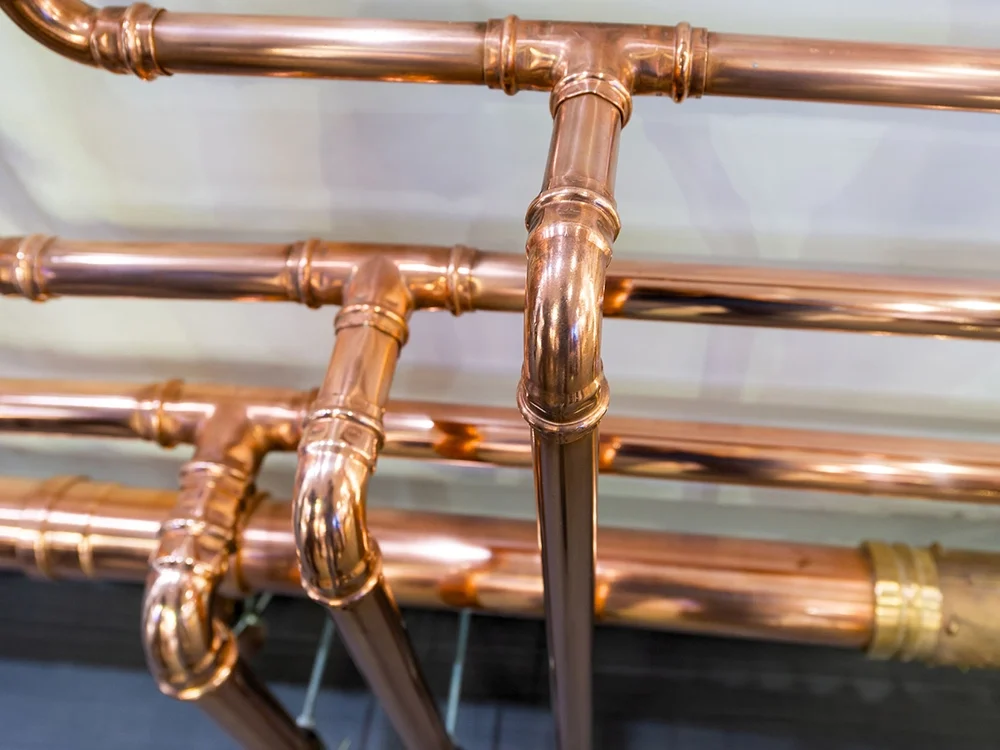
Copper has remained the industry standard for water transportation for decades because its material properties align closely with the requirements of fluid distribution systems.
Typical functions include:
The primary engineering advantages of copper include:
For these reasons, copper is generally specified wherever the primary objective is to transport fluids safely and efficiently over long distances.
→ For detailed mechanical and thermal property data across different copper alloy grades, see our copper material properties & engineering applications guide.
Engineering Roles of Brass in Plumbing Systems
Unlike copper, brass is rarely used for long sections of piping.
Instead, brass is selected where mechanical performance becomes more important than thermal conductivity.
Typical brass components include:
These components require precise machining, accurate threads, and long-term dimensional stability.
Brass provides several manufacturing and engineering advantages:
For precision plumbing components, brass often provides the best balance between performance, manufacturability, and cost.
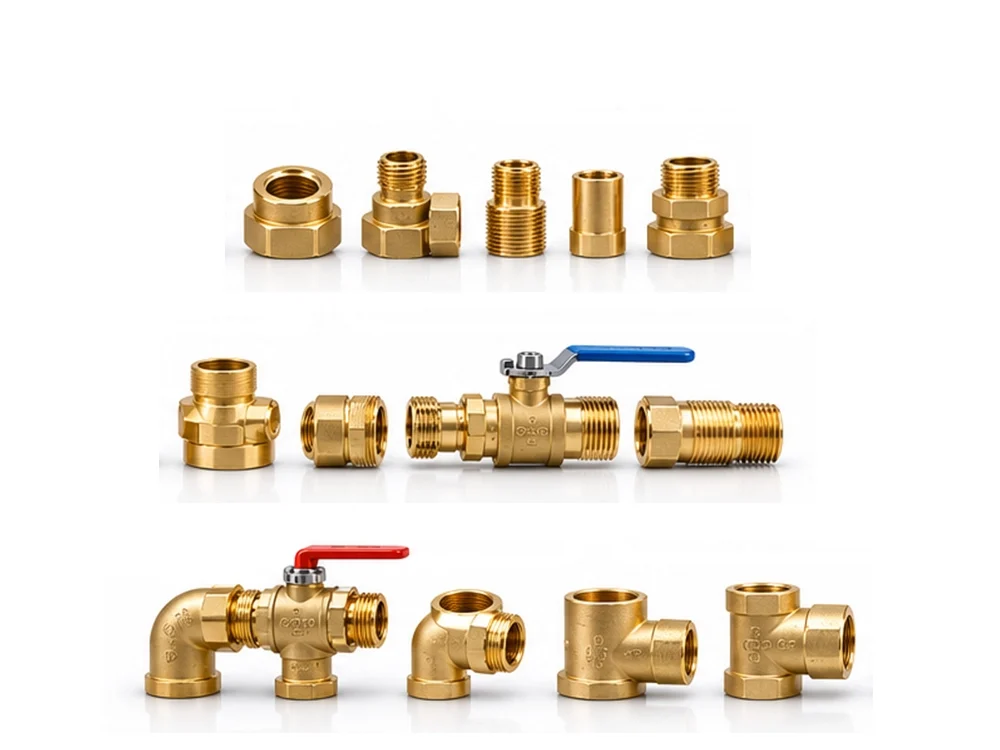
A modern plumbing system can be viewed as a combination of two complementary material systems.
Copper forms the network that transports water.
Brass forms the interfaces that connect, regulate, and control that network.
A simplified system may include:
Water Supply
↓
Copper Pipe
↓
Brass Elbow
↓
Copper Pipe
↓
Brass Tee
↓
Brass Ball Valve
↓
Copper Pipe
↓
Brass Threaded Adapter
↓
Equipment Connection
Each transition point is selected because brass can withstand repeated assembly, provide precise threaded engagement, and maintain reliable sealing under pressure.
This hybrid approach has become standard practice across commercial and industrial plumbing applications worldwide.
Why Engineers Rarely Replace Brass with Copper
Although copper offers excellent corrosion resistance, replacing every brass component with copper would create several engineering challenges.
Copper is softer than brass, making threaded connections more susceptible to deformation during repeated installation or maintenance.
Complex valve bodies and precision fittings also become more expensive to manufacture because copper is more difficult to machine efficiently.
Conversely, replacing all copper piping with brass would unnecessarily increase material costs and reduce the advantages of copper’s superior thermal conductivity.
For these reasons, professional engineers optimize each component individually rather than selecting a single material for the entire system.
The goal is not material consistency—it is overall system performance.
Material selection becomes much clearer when viewed in the context of real engineering projects.
In commercial and industrial plumbing systems, engineers rarely ask whether brass is better than copper. Instead, they determine which material performs best for each component based on operating conditions, maintenance requirements, manufacturing complexity, and expected service life.
The following examples illustrate how brass and copper are combined in different plumbing applications to achieve optimal performance.
Application 1-Commercial Building Water Supply Systems
Office buildings, hotels, shopping malls, hospitals, and educational facilities require plumbing systems that operate continuously for decades with minimal maintenance.
These systems contain hundreds or even thousands of pipe connections, making long-term reliability a primary design objective.
Material Selection
Copper
Brass
Why This Combination Works
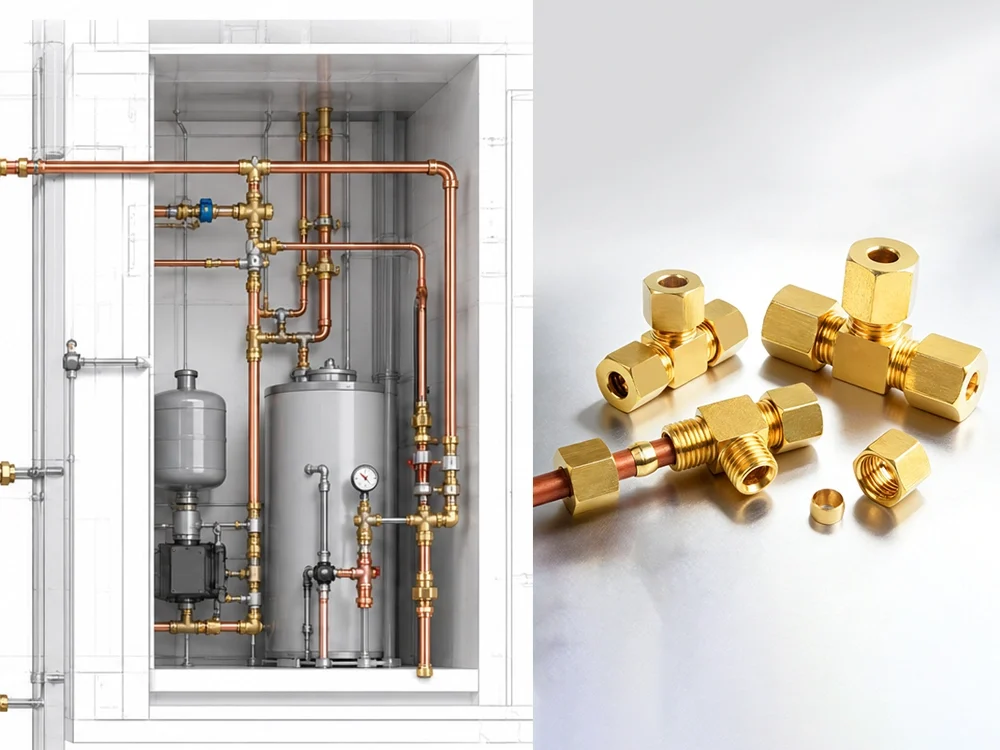
Copper provides excellent corrosion resistance and maintains consistent water quality over long pipe runs.
Brass offers the mechanical strength required for threaded joints, valves, and components that may be removed or replaced during maintenance. Our specialized lathe turning processes are particularly suited for manufacturing these precision threaded adapters and valve bodies—where thread quality and dimensional stability are critical.
Because brass is significantly easier to machine than pure copper, complex valve bodies and threaded fittings can be manufactured with greater precision while reducing production costs.
Application 2-HVAC Heating and Cooling Systems
HVAC systems experience continuous temperature changes, pressure fluctuations, and frequent maintenance cycles.
Materials must withstand thermal expansion while maintaining leak-free connections.
Material Selection
Copper
Brass
Why This Combination Works
Copper’s exceptional thermal conductivity maximizes heat transfer efficiency.
Brass provides stable threaded interfaces for control components that require periodic adjustment or replacement.
This combination allows HVAC equipment to maintain high operating efficiency while reducing maintenance downtime.
Application 3-Marine and Offshore Plumbing Systems
Marine environments expose plumbing systems to saltwater, humidity, vibration, and aggressive corrosion conditions.
Material selection directly affects maintenance frequency and service life.
Material Selection
Copper
DZR Brass / Naval Brass
Why This Combination Works
Marine-grade brass alloys provide improved resistance to dezincification and stress corrosion in aggressive environments.
Copper continues to offer excellent heat transfer performance, making it suitable for cooling systems.
Using specialized brass alloys for mechanical interfaces significantly extends equipment service life in marine applications.
Engineering Comparison Across Applications
| Application | Copper Components | Brass Components | Primary Engineering Benefit |
|---|---|---|---|
| Commercial Buildings | Water supply pipes | Valves, fittings, manifolds | Reliability and easy maintenance |
| HVAC Systems | Heat exchangers, refrigerant tubing | Control valves, adapters | Thermal efficiency and serviceability |
| Marine Systems | Cooling lines | Marine valves and connectors | Corrosion resistance and durability |
Key Takeaways
Brass and copper are both highly reliable plumbing materials when correctly specified and installed.
However, neither material is immune to failure.
In most cases, plumbing failures are not caused by poor material quality, but by selecting the wrong alloy, exposing components to unsuitable water chemistry, improper installation, or long-term environmental conditions that exceed the material’s design limits.
Understanding these failure mechanisms allows engineers to design systems with longer service life, lower maintenance costs, and improved operational reliability.
Quick Answer
Brass and copper rarely fail because of the base material itself.
Most failures are caused by:
Selecting the correct alloy for the operating environment is the most effective way to improve plumbing reliability.
What Is Dezincification?
Dezincification is a selective corrosion process in which zinc is gradually removed from brass alloys after prolonged exposure to certain water conditions.
As zinc dissolves, the remaining structure becomes porous, weak, and mechanically unstable.
Although the component may retain its original external appearance, its internal strength can be severely reduced.
This is one of the most common long-term failure mechanisms affecting standard brass plumbing fittings.
Conditions That Increase Dezincification Risk
The likelihood of dezincification increases under conditions such as:
Not every brass alloy is equally susceptible.
Modern DZR (Dezincification Resistant) brass alloys are specifically engineered to minimize this failure mechanism and are widely specified for potable water systems in many regions.
Not every brass alloy is equally susceptible. Modern DZR (Dezincification Resistant) brass alloys are specifically engineered to minimize this failure mechanism and are widely specified for potable water systems in many regions.
Engineering Recommendation
Where water chemistry presents an elevated corrosion risk, specify certified DZR brass instead of conventional brass. For a broader look at how zinc content affects different brass alloy grades—including DZR, naval brass, and standard yellow brass—see our guide on what brass is made of: composition, alloys & properties.
One of the most frequently misunderstood topics in plumbing engineering is galvanic corrosion.
Many buyers assume that connecting brass and copper automatically creates corrosion problems.
In reality, this is not generally the case.
Because brass is primarily composed of copper, the electrochemical potential difference between brass and copper is relatively small.
Under normal potable water conditions, brass fittings can be safely connected to copper pipes.
Galvanic corrosion becomes a concern only when additional factors are present, including:
Proper system design and compatible material selection significantly reduce this risk.
Engineering Recommendation
Brass and copper are generally considered compatible materials for plumbing systems—a point we also cover in our general brass and copper comparison alongside conductivity, hardness, and cost data that fall outside the scope of this plumbing-specific guide.
Greater attention should be given when connecting either material to galvanized steel, cast iron, or aluminum components.
Whenever mixed-metal systems are unavoidable, follow applicable plumbing codes and consider dielectric fittings where appropriate.
Unlike straight copper tubing, brass valves and threaded fittings experience repeated mechanical loading throughout their service life.
Typical examples include:
Brass performs well in these applications because of its higher hardness and better wear resistance compared with pure copper.
However, poor thread design, excessive tightening torque, or repeated overloading can still result in:
Correct installation procedures are as important as material selection.
Water chemistry often has a greater impact on plumbing reliability than material selection alone.
Important factors include:
| Water Condition | Potential Impact | Engineering Recommendation |
|---|---|---|
| High Chloride Content | Accelerated corrosion | Select DZR brass or corrosion-resistant alloys |
| Low pH Water | Increased metal dissolution | Evaluate water treatment and alloy compatibility |
| Hard Water | Mineral scale formation | Consider maintenance accessibility |
| Soft Water | Increased corrosion potential | Verify material compatibility |
| High Temperature | Accelerated aging | Select alloys suitable for elevated temperatures |
Evaluating water quality during the design stage significantly reduces long-term maintenance issues.
Many plumbing failures result from engineering decisions rather than material limitations.
Common examples include:
Preventing these mistakes usually provides greater lifecycle benefits than selecting a more expensive material.
Key Takeaways
Material selection does not end with engineering specifications. It also affects manufacturing efficiency, dimensional consistency, tooling costs, inspection methods, and overall production quality.
Although brass and copper belong to the same material family, they behave very differently during CNC machining.
At Chiheng Hardware, we have manufactured a wide range of precision brass and copper components for plumbing, fluid control, pneumatic, hydraulic, and industrial equipment applications. Through years of production experience, we have found that successful material selection requires balancing functional performance with manufacturing feasibility.
The following observations are based on practical machining experience rather than theoretical material data.
Quick Answer
From a manufacturing perspective, brass is generally the preferred material for precision-machined plumbing components because it machines faster, produces more stable chips, maintains tighter dimensional consistency, and reduces tool wear.
Copper remains the preferred material for applications requiring maximum electrical or thermal conductivity, but its softness and ductility make it more challenging to machine efficiently.
The best material is not always the easiest to machine—it is the one that best balances engineering performance, manufacturability, and lifecycle cost.
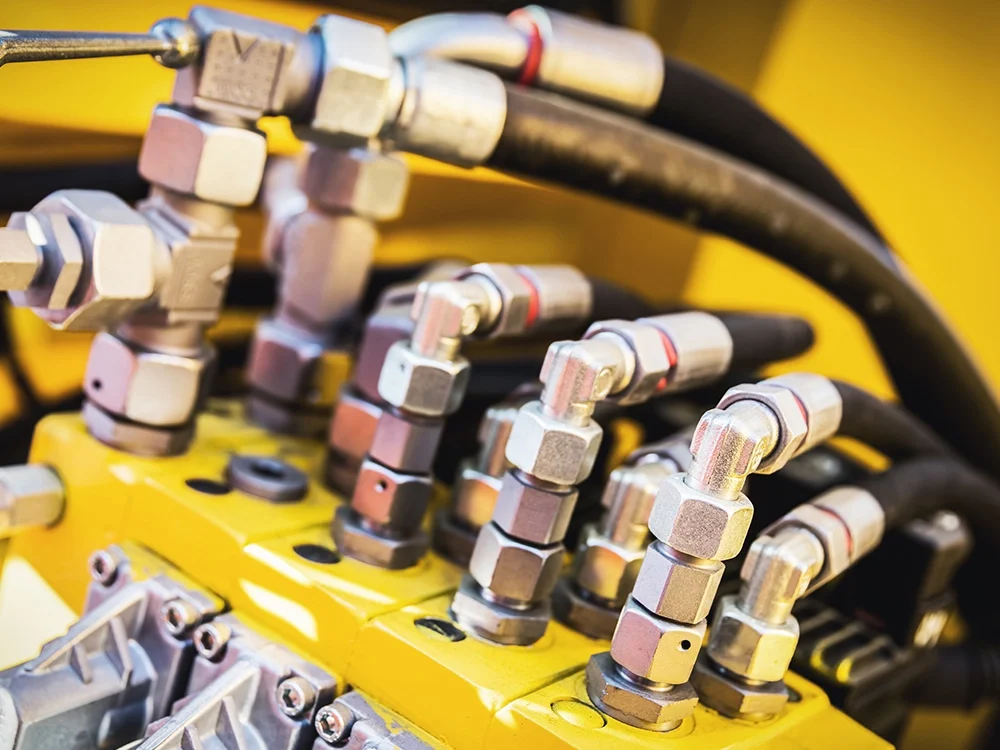
Brass has long been recognized as one of the easiest engineering metals to machine.
During CNC turning and milling, brass typically produces short, well-controlled chips that are easily evacuated from the cutting zone. This reduces the likelihood of chip entanglement, improves machining stability, and contributes to better surface quality.
Additional manufacturing advantages include:
These characteristics make brass particularly suitable for high-volume production of threaded fittings, valve bodies, manifolds, adapters, and precision plumbing components—all of which we regularly produce through our CNC milling service.
Copper offers outstanding functional performance but presents unique machining challenges.
Its high ductility causes chips to become longer and more difficult to control, increasing the likelihood of chip wrapping around cutting tools or workpieces.
Copper also tends to generate higher cutting temperatures and may promote built-up edge formation on cutting tools, affecting surface finish and dimensional consistency if machining parameters are not properly optimized.
Typical production considerations include:
These factors do not prevent copper from being machined successfully, but they often require greater process optimization than comparable brass components.
Typical Brass and Copper Components We Machine
Our production capabilities support a wide range of precision-machined components, including:
Each component requires different machining strategies, inspection methods, and finishing processes depending on its functional requirements.
Quality Control Throughout the Manufacturing Process
Precision machining extends beyond producing accurate dimensions.
Reliable plumbing components require consistent quality throughout every stage of production.
At Chiheng Hardware, inspection is integrated into the manufacturing workflow to verify that critical dimensions, thread quality, and geometric tolerances meet customer specifications.
Our quality control process typically includes:
For components with complex geometries or tight tolerance requirements, advanced coordinate measurement equipment is used to verify dimensional accuracy before shipment.
Quality assurance is not treated as a final inspection step but as an integral part of the manufacturing process.
Design Recommendations for Better Manufacturability
Many machining challenges can be avoided during the design stage.
Based on our manufacturing experience, we recommend that engineers consider the following principles when designing brass or copper plumbing components:
Early collaboration between designers and manufacturers often reduces machining costs while improving overall product quality.
Factory Experience
One observation repeatedly confirmed in production is that the easiest material to machine is not always the best material for the application.
For example, brass is often selected because it provides exceptional machining efficiency and dimensional consistency. However, when electrical conductivity or heat transfer is the primary requirement, copper remains the preferred engineering solution despite its greater manufacturing complexity.
The most successful projects begin by defining the functional requirements first and then optimizing the manufacturing process around the selected material—not the other way around.
This engineering-first approach helps customers achieve better product performance while maintaining efficient and cost-effective production.
Key Takeaways
One of the most common purchasing mistakes is selecting plumbing materials based solely on the initial material price.
While raw material cost is an important consideration, it represents only one part of the total investment over the lifetime of a plumbing system.
For commercial, industrial, and OEM projects, the Total Cost of Ownership (TCO) often has a greater impact on profitability than the purchase price of individual components.
An effective material selection strategy considers not only what a component costs to manufacture, but also how long it lasts, how easy it is to install, how often it requires maintenance, and how much downtime it may cause during its service life.
Quick Answer
Although brass and copper prices fluctuate with global metal markets, material cost alone should not determine the final selection.
For most plumbing applications:
The lowest purchase price does not always result in the lowest overall project cost.
The true cost of a plumbing component extends far beyond the purchase invoice.
Engineers and procurement teams should evaluate several cost factors throughout the product lifecycle.
| Cost Factor | Copper | Brass | Engineering Consideration |
|---|---|---|---|
| Raw Material Cost | Market-dependent | Market-dependent | Both fluctuate with copper and zinc prices. |
| CNC Machining Cost | Higher | Lower | Brass typically machines faster with less tool wear. |
| Installation Cost | Low | Low | Depends primarily on system design. |
| Maintenance Frequency | Low | Very Low | Brass fittings are highly durable under repeated servicing. |
| Replacement Cost | Low | Low | Influenced by accessibility and operating environment. |
| Service Life | Excellent | Excellent | Correct alloy selection is more important than material type. |
| Downtime Risk | Low | Low | Proper engineering design minimizes unexpected failures. |
Manufacturing Efficiency and Production Cost
From a manufacturing perspective, production efficiency often has a greater influence on component cost than raw material pricing.
Brass generally offers:
These advantages frequently reduce manufacturing costs for precision-machined plumbing components, particularly in medium- and high-volume production.
Copper may require additional machining optimization, especially for complex geometries, due to its higher ductility and chip control challenges.
Maintenance Cost Throughout the Service Life
Maintenance represents one of the largest long-term expenses in commercial plumbing systems.
Components that require frequent replacement, difficult disassembly, or extended downtime often generate costs far exceeding their original purchase price.
Brass components are widely used in valves, manifolds, and threaded fittings because they provide:
Copper piping, meanwhile, offers excellent long-term reliability for fluid transportation with minimal maintenance requirements when installed correctly.
The combination of these materials allows maintenance activities to focus primarily on serviceable brass components without replacing large sections of copper piping.
Lifecycle Cost Example
Consider a commercial office building requiring:
An optimized engineering approach might specify:
Copper
Brass
Although this hybrid solution may not minimize the initial purchase price of every individual component, it typically reduces:
As a result, the overall lifecycle cost is often lower than using a single material throughout the system.
Procurement Considerations for OEM Buyers
For OEM manufacturers and industrial procurement teams, selecting a material involves balancing technical performance with commercial objectives.
Key evaluation criteria include:
Rather than focusing exclusively on the lowest unit price, experienced buyers evaluate which material delivers the greatest value across the entire product lifecycle.
Key Takeaways
Material selection is rarely based on a single property such as strength or corrosion resistance.
Instead, engineers evaluate multiple technical and commercial factors simultaneously to determine which material delivers the best overall performance for a specific application.
The most effective material is not necessarily the strongest, the least expensive, or the easiest to machine—it is the material that best satisfies the functional requirements of the component throughout its entire service life.
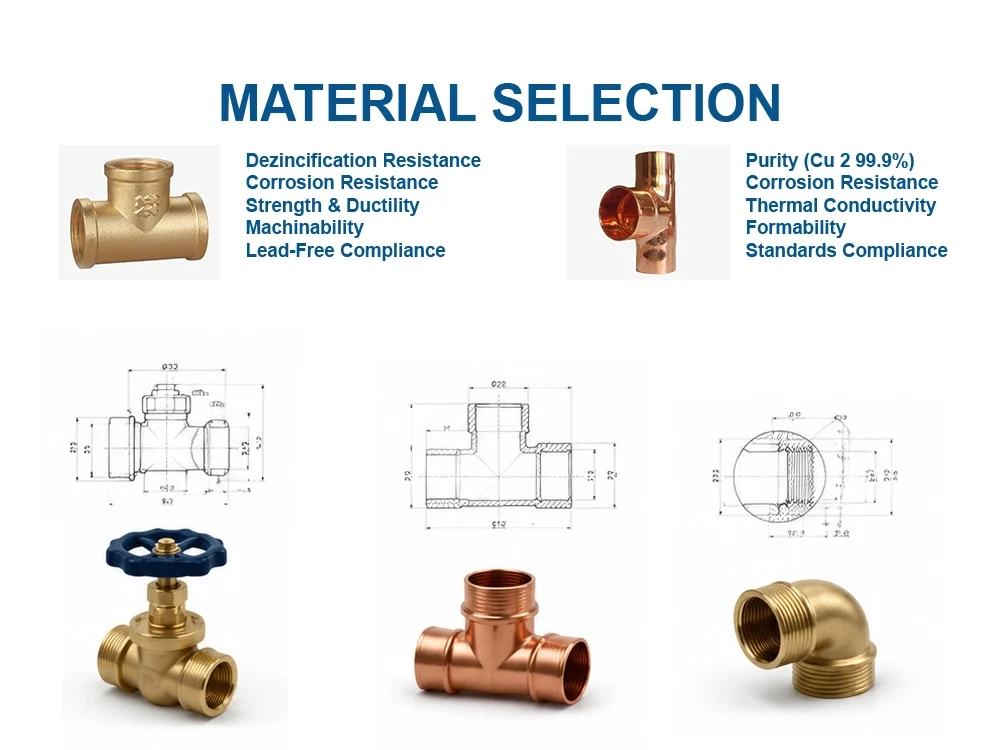
For this reason, professional engineering teams typically follow a structured decision-making process instead of relying on general material comparisons.
Quick Answer
There is no universal “best” material for plumbing applications.
Choose copper when heat transfer, water transportation, or electrical conductivity are the primary design requirements.
Choose brass when the component requires precision machining, threaded connections, pressure resistance, dimensional stability, or repeated maintenance.
For most commercial plumbing systems, combining both materials provides the best balance between performance, manufacturability, and lifecycle cost.
Step 1 — Define the Primary Function of the Component
The first question should always be:
What is this component expected to do?
Different functions require different material characteristics.
| Component Function | Recommended Material | Engineering Reason |
|---|---|---|
| Transport water | Copper | Excellent corrosion resistance and flow performance |
| Transfer heat | Copper | Outstanding thermal conductivity |
| Control water flow | Brass | High strength and wear resistance |
| Connect threaded pipes | Brass | Superior thread quality and machinability |
| Seal high-pressure systems | Brass | Better dimensional stability |
| Conduct electricity | Copper | Excellent electrical conductivity |
Selecting materials according to component function simplifies engineering decisions and improves long-term reliability.
Step 2 — Evaluate the Operating Environment
Environmental conditions often influence material selection more than mechanical properties.
Before specifying a material, evaluate:
For aggressive environments, selecting a corrosion-resistant alloy is often more important than choosing between brass and copper.
For example:
Step 3 — Consider Manufacturing Requirements
Material performance alone does not determine project success.
Manufacturing efficiency should also be considered during product development.
Questions include:
For precision-machined plumbing fittings, brass generally offers significant manufacturing advantages due to its excellent machinability and dimensional consistency.
Copper remains the preferred choice when functional performance outweighs manufacturing complexity.
Step 4 — Evaluate Maintenance and Serviceability
Maintenance requirements directly affect long-term operating costs.
Ask the following questions:
Components designed for repeated servicing often benefit from brass because of its higher wear resistance and more durable threaded connections.
Long sections of water piping generally benefit from copper’s excellent corrosion resistance and long service life.
Step 5 — Review Compliance and Industry Standards
Material selection should always comply with applicable engineering standards, customer specifications, and regional regulations.
Depending on the application, engineers may need to consider requirements related to:
Compliance should be confirmed before finalizing material selection or beginning production.
Before approving a material, review the following questions.
| Engineering Question | Copper | Brass |
|---|---|---|
| Does the component transport water? | ✓ | |
| Does it require maximum heat transfer? | ✓ | |
| Does it require electrical conductivity? | ✓ | |
| Does it contain precision-machined threads? | ✓ | |
| Does it operate under mechanical loading? | ✓ | |
| Will it be assembled and disassembled repeatedly? | ✓ | |
| Does it contain complex machined geometry? | ✓ | |
| Is long-term corrosion resistance critical? | ✓ | ✓ (with appropriate alloy selection) |
If several answers fall into both columns, a hybrid material solution is often the best engineering choice.
Key Takeaways
Selecting brass or copper is only the first step in developing a reliable plumbing component.
Once the material has been chosen, every subsequent manufacturing process—including machining, inspection, surface finishing, and assembly—must be optimized to preserve the material’s performance and ensure dimensional accuracy.
For precision plumbing components such as valves, threaded fittings, manifolds, adapters, and connectors, manufacturing quality often has as much influence on product performance as the material itself.
Even a well-designed component can fail prematurely if machining tolerances, thread quality, or inspection procedures are not properly controlled.
Quick Answer
High-quality plumbing components are the result of both correct material selection and precise manufacturing.
After selecting brass or copper, manufacturers must optimize CNC machining parameters, maintain tight dimensional tolerances, verify critical features through inspection, and ensure consistent production quality.
Engineering design and manufacturing quality work together to determine the long-term reliability of plumbing components.
Step 1 — Selecting the Appropriate Material Grade
Not all brass and copper materials are identical.
Different grades are developed to meet different engineering requirements, including:
Before production begins, engineers should confirm that the selected material grade matches the component’s operating environment and applicable standards.
Material traceability and incoming material verification are also essential for maintaining consistent production quality.
Step 2 — Precision CNC Machining
After raw material inspection, precision machining transforms the material into its final functional geometry.
Depending on component complexity, manufacturing may involve:
Critical machining considerations include:
Because brass and copper respond differently to cutting forces, machining strategies should be optimized for each material rather than applying identical machining parameters.
Step 3 — Dimensional Inspection and Quality Verification
Inspection is a critical stage in the manufacturing process.
Precision plumbing components often contain features that directly influence sealing performance and system reliability, including:
Inspection methods may include:
Verifying these characteristics during production helps identify deviations before components reach assembly or shipment.
Step 4 — Surface Finishing and Component Protection
Many plumbing components receive additional finishing processes to improve appearance, corrosion resistance, or application-specific performance.
Common finishing options include:
The appropriate finishing process depends on the selected material, operating environment, and customer specifications.
Surface treatment should complement the material’s engineering properties rather than compensate for poor manufacturing quality.
Step 5 — Final Quality Assurance Before Delivery
Before shipment, finished components should undergo final verification to confirm that they meet customer requirements.
Typical quality checks include:
For industrial and OEM customers, maintaining consistent production quality across multiple batches is often as important as meeting the specification for a single part.
Repeatability is a defining characteristic of precision manufacturing.
Manufacturing quality directly affects several aspects of plumbing system performance, including:
| Manufacturing Factor | Potential Impact |
|---|---|
| Dimensional Accuracy | Proper sealing and assembly |
| Thread Quality | Reduced leakage and easier installation |
| Surface Finish | Improved sealing performance |
| Material Consistency | Reliable mechanical properties |
| Inspection Quality | Reduced production variation |
| Process Stability | Consistent product performance across batches |
Reliable plumbing components result from consistent manufacturing processes rather than individual inspections alone.
Factory Experience
One lesson repeatedly confirmed through production is that achieving reliable plumbing performance requires much more than selecting the correct material.
For example, even a high-quality brass alloy cannot compensate for poorly machined threads, inadequate dimensional control, or inconsistent inspection practices.
Similarly, a correctly machined copper component may still underperform if the selected alloy does not match the intended operating environment.
Successful manufacturing therefore depends on controlling every stage of production—from material verification to final inspection—rather than relying on a single quality checkpoint.
Key Takeaways
Choosing between brass and copper is rarely about identifying a universally superior material. Successful engineering decisions are based on understanding the function of each component, the operating environment, manufacturing requirements, and long-term maintenance expectations.
The following recommendations summarize the principles discussed throughout this guide and provide practical guidance for real-world plumbing applications.
Expert Recommendation 1 — Choose Materials Based on Component Function
Do not select a material for the entire plumbing system simply because it performs well in one application.
Copper is typically the preferred choice for transporting water and transferring heat, while brass is generally better suited for valves, threaded fittings, manifolds, and other precision-machined components.
Matching the material to the component’s function improves overall system reliability and reduces unnecessary costs.
Expert Recommendation 2 — Consider the Operating Environment Before Selecting an Alloy
Environmental conditions often determine whether a component will provide decades of reliable service or fail prematurely.
Evaluate factors such as water chemistry, chloride concentration, operating temperature, pressure, humidity, and exposure to corrosive environments before finalizing the material specification.
Where aggressive conditions exist, corrosion-resistant alloys such as DZR brass or naval brass may provide a better long-term solution than standard brass.
Expert Recommendation 3 — Evaluate Manufacturability and Manufacturing Quality Together
Selecting the right material is only half the decision. Manufacturing execution determines whether that material’s properties are actually realized in the finished component.
For precision-machined plumbing components, brass generally offers easier machinability and more stable dimensional consistency, while copper requires additional process optimization. Either way, choosing a manufacturing partner with proven quality control processes—covering thread accuracy, dimensional inspection, and surface finish—is as important as the material specification itself.
Expert Recommendation 4 — Think in Terms of Lifecycle Cost, Not Material Price
The lowest-cost material is not always the most economical solution.
When evaluating brass and copper, consider machining efficiency, installation, maintenance, service life, replacement costs, and operational downtime—not just the initial purchase price.
A well-designed hybrid system often delivers a lower Total Cost of Ownership than a system based entirely on one material.
Expert Recommendation 5 — Verify Compliance with Applicable Standards
Before approving a design for production, confirm that the selected material complies with relevant industry standards, customer specifications, and regional regulations.
Requirements may include drinking water approvals, pressure equipment standards, HVAC specifications, or marine certifications depending on the intended application.
Compliance should always be verified during the design stage rather than after production has begun.
Expert Recommendation 6 — Use Brass and Copper Together Whenever Appropriate
The question should not always be “Which material is better?”
A more effective question is:
“How can these materials complement one another?”
Modern plumbing systems intentionally combine copper pipes with brass valves, fittings, and connectors because each material performs a different engineering function.
This hybrid approach improves manufacturability, simplifies maintenance, and enhances long-term system performance.
Expert Recommendation 7 — Select a Manufacturing Partner That Understands Engineering
Reliable production depends on more than machine capacity.
An experienced manufacturing partner should be able to provide support in:
Engineering collaboration during product development often reduces cost while improving product quality.
Key Takeaways
Engineering decisions should not rely solely on material properties or supplier recommendations.
For plumbing components used in commercial buildings, industrial equipment, HVAC systems, and OEM products, internationally recognized standards provide a common technical language that helps manufacturers, engineers, and buyers specify materials consistently and verify product performance.
Following established standards also improves product compatibility, simplifies procurement, supports regulatory compliance, and reduces the risk of material substitution or manufacturing inconsistencies.
Whenever possible, engineering drawings and purchasing documents should reference the applicable material, dimensional, and testing standards.
Quick Answer
International standards help ensure that brass and copper plumbing components meet consistent requirements for material composition, dimensions, performance, testing, and safety.
Instead of relying on generic material descriptions, engineers typically specify recognized standards covering:
Using internationally accepted standards improves product consistency and reduces engineering risk.
Common Standards Used for Brass and Copper Plumbing Components
Although the applicable standards vary by country and application, several organizations publish specifications that are widely referenced throughout the plumbing industry.
| Organization | Typical Scope | Common Applications |
|---|---|---|
| ASTM International | Material specifications and testing methods | Brass alloys, copper alloys, mechanical testing |
| ASME | Pressure systems and piping standards | Industrial piping, valves, pressure equipment |
| ISO | International quality and manufacturing standards | Dimensions, quality systems, manufacturing consistency |
| NSF | Drinking water safety certification | Potable water plumbing products |
| CSA | Plumbing and building product certification | North American plumbing systems |
| EN Standards | European material and plumbing specifications | Commercial and residential construction |
The specific standard depends on the intended application and regional market.
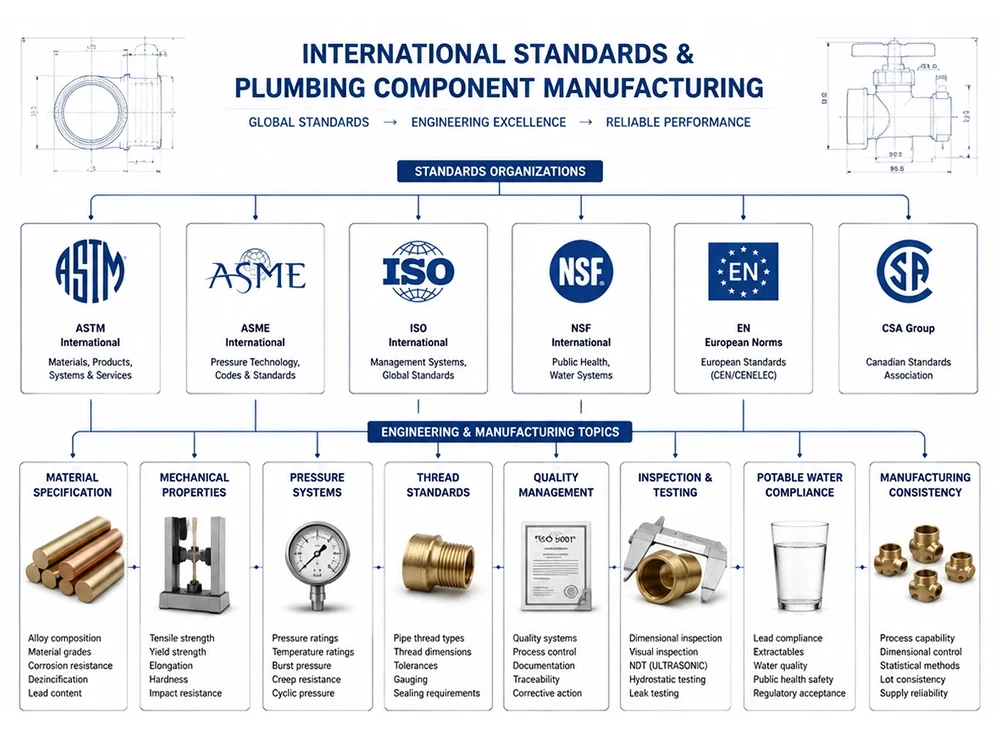
Material Standards Engineers Frequently Reference
When specifying brass or copper materials, engineers often refer to internationally recognized material grades rather than commercial trade names.
Typical specifications may define:
Using standardized material grades helps ensure consistency between suppliers and production batches.
Material traceability is particularly important for OEM manufacturing and regulated industries.
Standards for Threads, Dimensions, and Interchangeability
Even when the correct material is selected, poorly defined dimensions can lead to assembly problems and leakage.
Industry standards help ensure that components produced by different manufacturers remain interchangeable.
Important dimensional considerations include:
Following standardized dimensions simplifies installation, maintenance, and future component replacement.
Drinking Water and Regulatory Compliance
For components intended for potable water systems, regulatory compliance extends beyond mechanical performance.
Depending on the target market, engineers may need to verify requirements related to:
Compliance requirements vary by country and should always be confirmed before product development or procurement begins.
Material selection alone does not guarantee regulatory approval.
Quality Management Standards
Reliable manufacturing depends on consistent production processes as well as material quality.
Many industrial buyers evaluate suppliers based on their quality management systems, including:
A robust quality management system supports repeatable manufacturing and reduces quality variation between production batches.
Engineering Documentation Best Practices
When preparing engineering drawings or purchasing specifications, include sufficient technical information to avoid ambiguity.
Typical documentation should identify:
Clear documentation reduces communication errors between design teams, manufacturers, and suppliers.
Key Takeaways
The question “Which is better, brass or copper?” does not have a universal answer.
Throughout this guide, one principle has remained consistent:
The best material depends on the function of the component, the operating environment, manufacturing requirements, maintenance expectations, and lifecycle objectives.
Successful plumbing systems are not built by choosing a single material for every application.
Instead, they are designed by selecting the most appropriate material for each individual component.
Copper and brass are complementary engineering materials—not competing alternatives.
For most commercial, industrial, and OEM plumbing applications:
This engineering approach consistently delivers the highest levels of reliability, maintainability, and long-term value.
What Engineers and Buyers Should Remember
Whether you are designing a new plumbing assembly, sourcing precision-machined fittings, or evaluating alternative materials, ask the following questions before making a final decision:
Answering these questions systematically leads to better engineering decisions and lower long-term project risk.
Final Engineering Statement
Brass and copper have remained essential engineering materials for generations because they solve different problems exceptionally well.
Copper excels in transporting water and transferring heat.
Brass excels in connecting, controlling, sealing, and supporting mechanical systems.
When engineers understand these complementary strengths and apply them systematically, they create plumbing systems that are more reliable, easier to maintain, more efficient to manufacture, and better suited to long-term operation.
Ultimately, successful material selection is not about choosing brass or copper.
It is about selecting the right material for the right function.
It depends on the application. Copper is generally preferred for water supply pipes because of its excellent corrosion resistance and thermal conductivity. Brass is usually the better choice for fittings, threaded connectors, and valve bodies because it offers higher mechanical strength, better machinability, and lower manufacturing cost. In most systems, the two materials work together rather than compete.
Yes. Because brass is primarily composed of copper, the electrochemical potential difference between the two metals is small, so under normal potable water conditions brass fittings can be safely connected to copper pipes. Galvanic corrosion becomes a concern mainly when other metals — such as carbon steel or galvanized steel — are introduced into the system, or when conductive electrolytes and poor electrical isolation are present.
Copper pipes are typically long, straight, reddish-orange tubing runs used for water supply lines, hot/cold branches, and risers, usually joined by soldering. Brass is rarely used for long pipe runs — it appears instead as yellowish, machined components: valve bodies, threaded elbows, tees, adapters, and compression fittings at connection points. If you see a golden/yellow machined fitting joining copper tubing, that fitting is brass.
Lead-free brass alloys are formulated to meet drinking water safety regulations that restrict lead content, while older leaded brass formulations do not. For potable water systems, engineers should verify the alloy meets applicable lead-content restrictions, drinking water safety certifications (such as NSF), and regional regulatory requirements before specification — compliance should be confirmed at the design stage, not after production.
Dezincification is a selective corrosion process where zinc is gradually leached out of a brass alloy under conditions like high chloride content, soft or acidic water, elevated temperature, or stagnant water. The fitting can look normal on the outside while becoming porous and mechanically weak inside. Modern DZR (Dezincification-Resistant) brass alloys are engineered specifically to resist this failure mode and are widely specified for potable water systems in high-risk water chemistries.
The applicable alloy depends on the component and its exposure conditions rather than a single default. Standard yellow brass (higher zinc content) is common for general threaded fittings and valves, while red brass, DZR brass, and naval brass alloys (lower zinc, better dezincification and stress-corrosion resistance) are specified for aggressive water chemistry or marine environments.
Both perform well in standard potable water when the correct alloy is used, but for outdoor, marine, or high-chloride environments, standard brass is not always sufficient. Copper continues to offer strong corrosion resistance and heat transfer for cooling circuits, while DZR brass or naval brass is specified for valves, pump connectors, and threaded fittings exposed to saltwater or aggressive water chemistry.
Start by defining the component's primary function (transport, control, or seal), then evaluate the operating environment (water chemistry, chloride level, temperature, marine exposure), manufacturing requirements (thread precision, tolerance, production volume), and serviceability. Components under repeated mechanical loading or requiring precision threads generally call for brass; select DZR or naval brass specifically where water chemistry or marine exposure is aggressive.
Material choice should follow the component's function, pressure rating, water chemistry, and machining requirements rather than a blanket preference. Brass remains the standard choice for precision-machined valves and threaded fittings due to its machinability and cost efficiency; stainless steel is typically considered where higher corrosion resistance or structural strength is required beyond what brass alloys provide.
Because they solve different engineering problems: copper efficiently transports water and transfers heat over long runs, while brass provides the mechanical strength, thread quality, and wear resistance needed at valves, fittings, and connection points that are repeatedly assembled or serviced. Most commercial, HVAC, and marine systems combine both by design.
No. Raw material price is only one part of Total Cost of Ownership. Brass typically reduces CNC machining cost and cycle time due to better machinability, while copper often delivers lower lifecycle cost for long water-distribution runs due to its durability and corrosion resistance. A hybrid system — copper for transport, brass for valves and fittings — frequently produces the lowest overall lifecycle cost.
Stop thinking more, fill out the blank below, and send us an inquiry, and you will have a professional team of board game custom products contact you to answer any questions and provide pricing.
You can send us any questions to get any information you would like to know, and we will respond to you in extremely short time.