

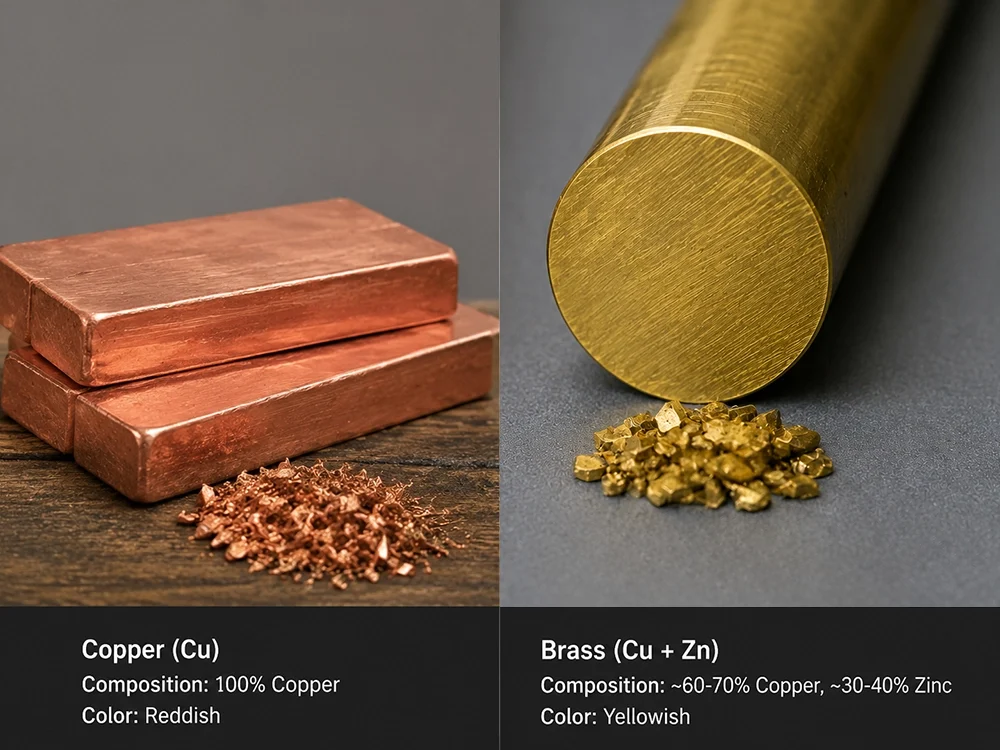
Brass is a copper-zinc alloy made primarily from 60–70% copper and 30–40% zinc, although the exact composition varies depending on the alloy grade and intended application. Unlike pure copper, brass combines the properties of two metals to achieve higher strength, better machinability, improved corrosion resistance, and a distinctive golden appearance.
Because brass contains no iron, it cannot rust like carbon steel. Instead, it may gradually develop a thin surface tarnish over time, while the underlying metal remains structurally stable in most environments. This combination of durability, workability, and corrosion resistance makes brass one of the world’s most widely used engineering materials for plumbing fittings, valves, electrical connectors, precision machined components, heat exchangers, and decorative hardware.
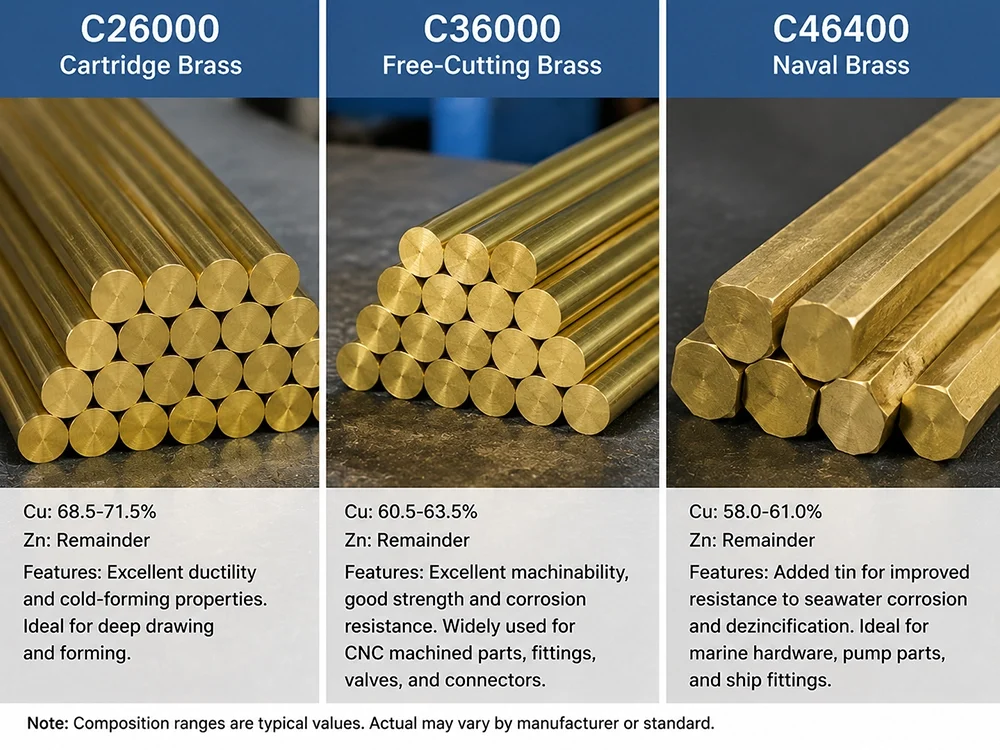
The most common brass alloys include C260 (Cartridge Brass) for cold forming, C360 (Free-Cutting Brass) for CNC machining, C464 (Naval Brass) for marine applications, and lead-free brass alloys designed for potable water systems that comply with modern environmental regulations.
In short, brass is not a pure metal but an engineered alloy whose composition can be adjusted to balance strength, corrosion resistance, electrical conductivity, appearance, and manufacturing cost for different industrial applications.
Many people ask “What is brass made of?”, but an equally important question is whether brass is a metal, an alloy, or a chemical compound. The correct answer is that brass is an alloy—not a pure metal and not a chemical compound.
A pure metal consists of only one metallic element. Copper, zinc, aluminum, and iron are all pure metals because each is composed of a single type of atom.
An alloy is a material created by combining two or more elements—at least one of which is a metal—to achieve properties that cannot be obtained from the individual materials alone. Brass is produced by melting copper and zinc together, allowing their atoms to mix within the metal’s crystal structure. The result is a new engineering material with improved strength, machinability, wear resistance, and corrosion resistance compared with pure copper.
By contrast, a chemical compound forms when atoms are chemically bonded together in fixed proportions. Water (H₂O) and sodium chloride (NaCl) are common examples. Brass does not have a fixed chemical formula because its copper and zinc percentages vary depending on the alloy grade. For this reason, brass is classified as an alloy rather than a compound.
From a microscopic perspective, copper and zinc atoms remain metallic atoms distributed throughout the crystal lattice. They are not joined by permanent chemical bonds but by metallic bonding, allowing manufacturers to adjust the composition for different mechanical, electrical, and corrosion-resistance requirements.
In summary, brass is an engineered copper-zinc alloy whose composition can be modified to optimize performance for plumbing, machining, electrical, marine, and architectural applications.
Table 1. Pure Metal vs Alloy vs Compound
Material Type | Composition | Fixed Formula | Example | Brass Belongs? |
Pure Metal | One metallic element | No | Copper, Zinc, Iron | ✗ |
Alloy | Two or more elements (at least one metal) | No | Brass, Bronze, Stainless Steel | ✓ |
Chemical Compound | Chemically bonded atoms | Yes | Water (H₂O), Salt (NaCl) | ✗ |
The composition of brass is primarily determined by the ratio of copper (Cu) and zinc (Zn). While people often refer to brass as a single material, there are actually hundreds of brass alloys, each engineered for different manufacturing processes and performance requirements.
For most commercial brass products, copper accounts for approximately 60–70% of the alloy, while zinc typically makes up 30–40%. Increasing the copper content generally improves corrosion resistance, ductility, electrical conductivity, and gives the alloy a warmer reddish-gold appearance. Increasing the zinc content increases strength, hardness, and machining efficiency while reducing raw material cost.
In addition to copper and zinc, many brass grades contain small amounts of alloying elements to enhance specific properties. Lead may be added to improve machinability in free-cutting brass, while tin, aluminum, silicon, manganese, or arsenic can improve corrosion resistance, wear resistance, or dezincification resistance for demanding industrial environments.
Rather than asking “What is brass made of?”, engineers usually ask “Which brass alloy composition best matches the application?” because even small changes in composition can significantly influence machining performance, service life, corrosion resistance, and manufacturing cost.
Table 2. Typical Elements Found in Brass
Element | Typical Content | Primary Function |
Copper (Cu) | 60–70% | Corrosion resistance, ductility, electrical conductivity |
Zinc (Zn) | 30–40% | Strength, hardness, lower material cost |
Lead (Pb)* | 0–3.5% (selected alloys) | Improves CNC machinability |
Tin (Sn) | Trace | Improves marine corrosion resistance |
Silicon / Aluminum / Manganese | Trace | Improves wear resistance and mechanical performance |
*Many modern plumbing and potable water applications now use lead-free brass alloys to comply with international drinking water regulations.
Although all brass is made from copper and zinc, different brass alloys are designed for different engineering applications. Adjusting the copper-to-zinc ratio—or adding small amounts of other elements—changes the alloy’s strength, machinability, corrosion resistance, color, and forming characteristics.
The following brass grades are among the most widely used international alloys.
Table 3. Common Brass Alloy Comparison
Brass Alloy | Typical Copper Content | Key Characteristics | Common Applications |
C260 (Cartridge Brass) | ~70% | Excellent ductility and cold-forming performance | Ammunition cases, radiator components, deep-drawn parts |
C270 (Yellow Brass) | ~65% | Good balance of strength, formability, and cost | Architectural hardware, decorative products |
C280 (Muntz Metal) | ~60% | Higher strength and wear resistance | Marine fasteners, structural hardware |
C360 (Free-Cutting Brass) | ~61.5% | Outstanding CNC machinability with excellent dimensional accuracy | Precision machined parts, valves, fittings, electrical connectors |
C464 (Naval Brass) | ~60% | Tin-enhanced resistance to seawater corrosion and dezincification | Marine hardware, propeller shafts, ship fittings |
C230 (Red Brass) | ~85% | High corrosion resistance and excellent thermal conductivity | Plumbing systems, heat exchangers, architectural applications |
Among these alloys, C360 Free-Cutting Brass is the preferred choice for CNC machining because it offers one of the highest machinability ratings among copper alloys, reducing machining time while maintaining excellent dimensional consistency.
For environments exposed to seawater or chloride-rich conditions, C464 Naval Brass is widely selected because the addition of tin significantly improves resistance to corrosion and dezincification.
When maximum formability is required, C260 Cartridge Brass is preferred for deep drawing and cold-working operations, while C230 Red Brass is commonly specified for plumbing and heat-transfer systems where corrosion resistance is more important than machining speed.
For most industrial buyers, selecting the correct brass alloy is more important than simply choosing “brass,” because alloy composition directly determines manufacturing efficiency, service life, and long-term reliability.
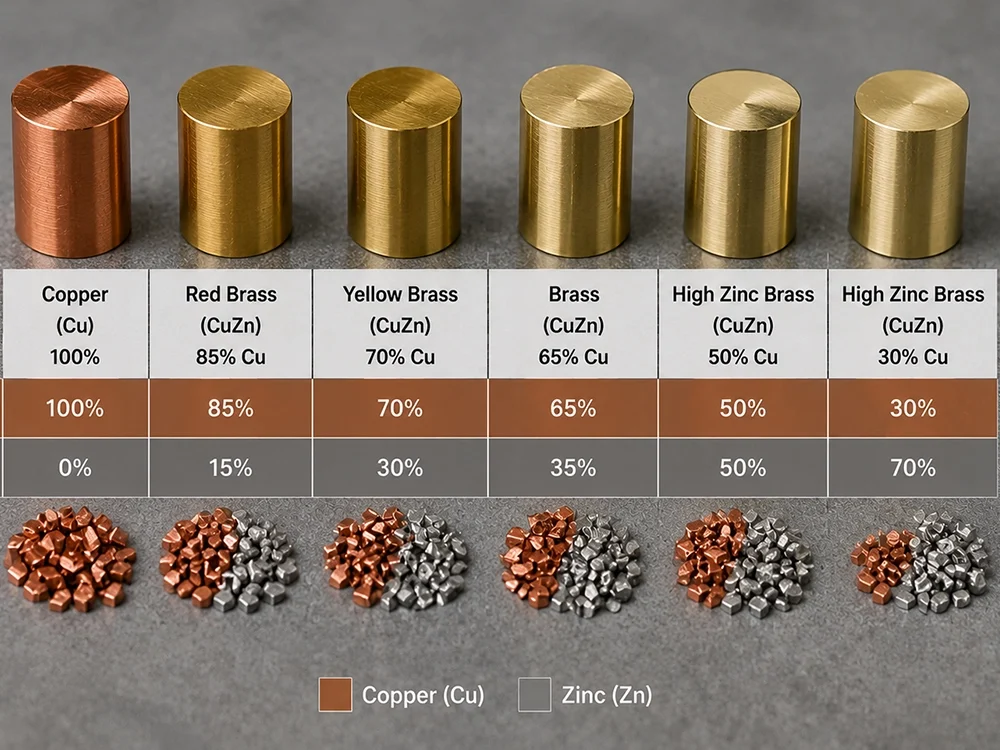
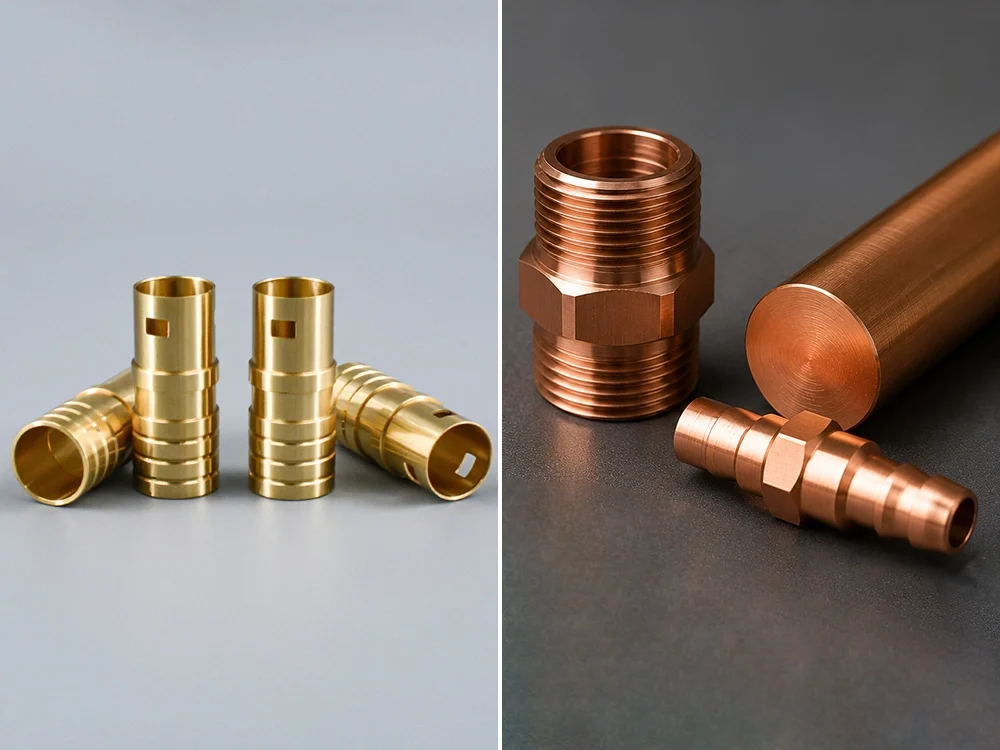
One of the most frequently asked questions about brass is “Why is brass yellow?” The answer lies in its chemical composition. The color of brass is determined primarily by the ratio of copper and zinc. As the copper content increases, brass gradually changes from bright yellow to warm golden and eventually to a reddish tone. Increasing the zinc content produces a lighter yellow appearance while also improving strength and reducing material cost.
This is why brass is not available in only one color. Different alloy grades are intentionally formulated to achieve different appearances while maintaining specific mechanical and corrosion-resistant properties.
Table 4. How Composition Affects Brass Color
Brass Type | Typical Copper Content | Appearance | Typical Applications |
Yellow Brass | 60–65% | Bright yellow | Plumbing fittings, valves, decorative hardware |
Standard Brass | 65–70% | Golden yellow | CNC machined parts, electrical components, architectural hardware |
Red Brass | 80–90% | Reddish gold | Plumbing systems, heat exchangers, premium architectural products |
Although many people describe brass as “gold-colored metal,” brass does not contain gold. Its golden appearance is entirely produced by the optical properties of the copper-zinc alloy. Depending on surface finishing processes such as polishing, brushing, sandblasting, or electroplating, the same alloy can also exhibit noticeably different visual effects.
For industrial buyers, color is often more than an aesthetic consideration. A higher copper content usually indicates better corrosion resistance and improved ductility, while higher zinc content generally offers better machinability and lower production cost. Therefore, alloy selection should always be based on engineering requirements rather than appearance alone.
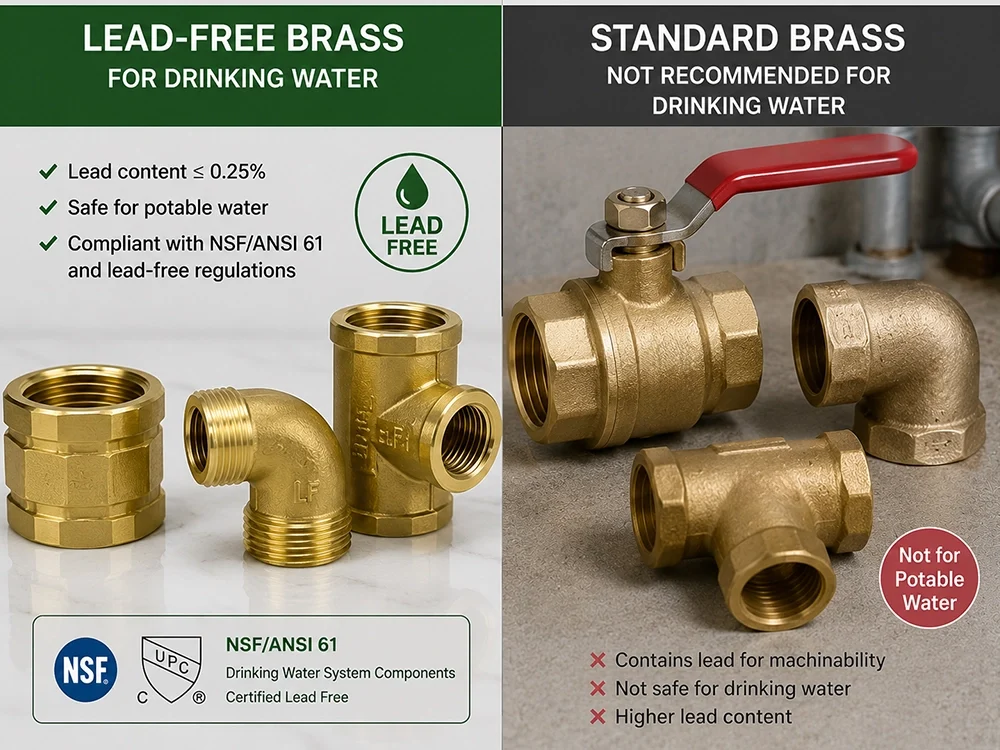
Not all brass is lead-free. Whether a brass alloy contains lead depends on its intended application and manufacturing requirements. While many traditional brass grades include a small amount of lead to improve machining performance, an increasing number of modern brass alloys are manufactured without intentionally added lead to comply with drinking water regulations and environmental standards.
Lead has historically been added to free-cutting brass alloys, such as C360, because it acts as a chip breaker during machining. This significantly improves tool life, machining speed, and surface finish, making leaded brass one of the most efficient materials for high-volume CNC production.
However, for applications involving potable water, food processing, medical equipment, and environmentally regulated markets, manufacturers increasingly specify lead-free brass. These alloys replace lead with carefully controlled alloying elements while maintaining good mechanical properties and corrosion resistance.
Table 5. Leaded Brass vs Lead-Free Brass
Material | Contains Lead? | Primary Advantage | Typical Applications |
Leaded Brass | Yes (selected alloys) | Excellent machinability and production efficiency | CNC machined parts, valves, industrial components |
Lead-Free Brass | No intentionally added lead | Drinking water compliance and environmental safety | Plumbing fittings, potable water systems, sanitary equipment |
It is important to understand that “lead-free” does not mean every brass alloy is naturally lead-free. It simply refers to alloys specifically designed to satisfy applicable regulatory limits. Therefore, engineers and purchasing teams should always specify the required alloy grade and certification instead of assuming that all brass materials meet the same compliance standards. For plumbing-specific material selection, see our detailed guide on Brass vs. Copper Plumbing: Which Material Should You Specify for Pipes, Fittings, and Valves?, which compares corrosion resistance, cost, and code compliance for pipe, fitting, and valve applications.
Copper is naturally corrosion-resistant and highly conductive, but pure copper is relatively soft, expensive, and difficult to machine efficiently. By adding zinc, manufacturers create brass—a copper alloy that offers a better balance of strength, manufacturability, durability, and cost.
The amount of zinc added directly influences the properties of the alloy. As zinc content increases, brass generally becomes stronger, harder, and easier to machine, making it well suited for high-volume manufacturing. Zinc also lowers the melting temperature of the alloy, improving casting performance and reducing production energy consumption.
However, increasing zinc content is not always beneficial. Excessive zinc may reduce ductility, electrical conductivity, and corrosion resistance in certain environments. For this reason, brass alloys are carefully engineered so that the copper-to-zinc ratio matches the intended application rather than maximizing one property alone.
For example, plumbing fittings usually prioritize corrosion resistance and long service life, while precision CNC components often prioritize machining efficiency. Marine hardware requires enhanced resistance to seawater, whereas electrical connectors require higher electrical conductivity. Each application therefore uses a different balance of copper and zinc.
In engineering, zinc is not simply an additive—it is the alloying element that transforms soft copper into a versatile industrial material suitable for thousands of commercial products.
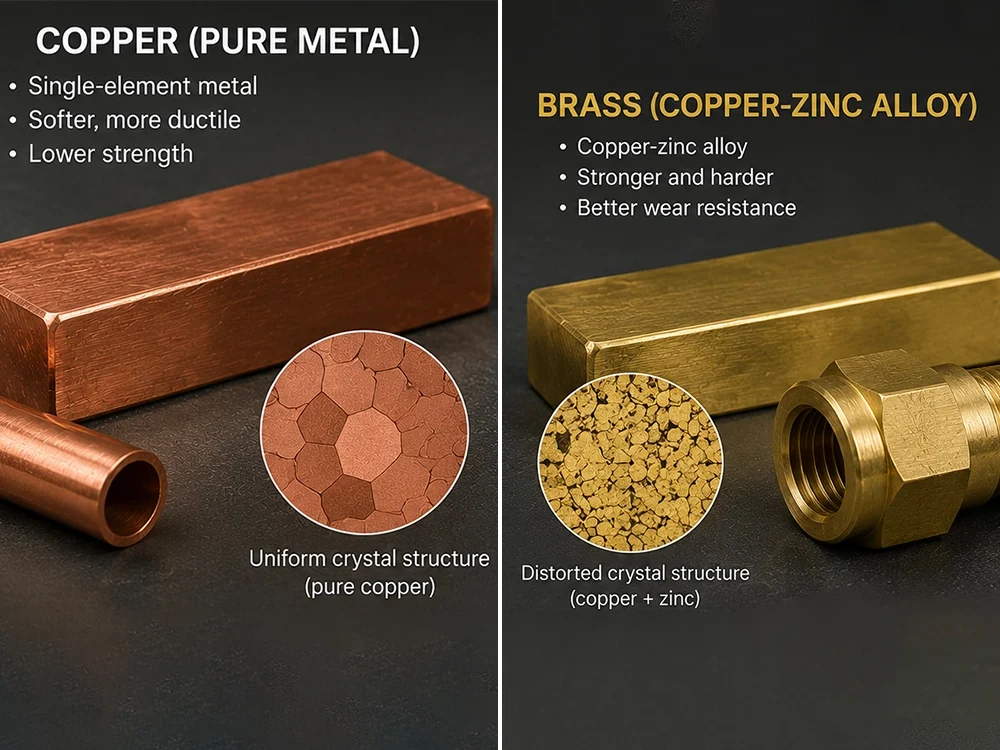
A common question in materials engineering is “Why is brass stronger than pure copper?” The answer lies in how alloying changes the internal structure of the metal.
Pure copper contains atoms of nearly identical size arranged in a regular crystal lattice. Because these atomic layers can slide past one another relatively easily, copper is highly ductile and electrically conductive, but it is also comparatively soft.
When zinc atoms are introduced, they replace some of the copper atoms within the crystal lattice. Since zinc atoms differ slightly in size, they create microscopic distortions that make it more difficult for atomic layers to move under stress. This strengthening mechanism is known as solid solution strengthening, and it is one of the fundamental principles of metallurgy.
As a result, brass generally offers higher hardness, greater tensile strength, better wear resistance, and improved dimensional stability than pure copper. At the same time, it still retains sufficient ductility for forming, bending, and machining, making it one of the most versatile engineering materials available.
Compared with bronze, brass is also easier to machine and cold-form in many applications because its alloy structure provides an effective balance between strength and plastic deformation. This is one reason why brass is widely used for precision machined components, plumbing fittings, valves, electrical connectors, and architectural hardware.
In simple terms, brass is stronger than copper because alloying with zinc makes it more difficult for the metal’s crystal structure to deform while still preserving good workability. To understand the baseline properties that alloying modifies, see our engineering reference on Copper Material Properties & Engineering Applications, covering hardness, weight, conductivity, and how copper compares across common alloy families.
Copper, brass, and bronze are all copper-based materials, but they are designed for different engineering purposes. Copper is a pure metal, while brass is a copper-zinc alloy and bronze is primarily a copper-tin alloy. The alloying elements give each material a distinct balance of strength, corrosion resistance, conductivity, machinability, and wear performance.
For applications requiring the highest electrical or thermal conductivity, pure copper remains the preferred choice. When manufacturers need an economical material that combines good corrosion resistance with excellent machinability, brass is typically the best option. Bronze, on the other hand, is commonly selected for demanding environments where wear resistance, bearing performance, or heavy mechanical loading are more important than machining efficiency.
Property | Copper | Brass | Bronze |
Primary Composition | Copper | Copper + Zinc | Copper + Tin (or other alloying elements) |
Strength | Medium | High | High |
Machinability | Fair | Excellent | Moderate |
Electrical Conductivity | Excellent | Good | Moderate |
Corrosion Resistance | Excellent | Excellent | Excellent |
Wear Resistance | Moderate | Good | Excellent |
Typical Applications | Electrical wiring, busbars, heat exchangers | Valves, fittings, CNC parts, connectors | Bearings, bushings, marine components, heavy-duty machinery |
For most industrial purchasing decisions, there is no universally “best” copper alloy. The optimal material depends on the product’s operating environment, manufacturing process, performance requirements, and cost target.
Want a more detailed comparison? If you’re deciding specifically between brass and copper, our Brass VS Copper Guide breaks down which material wins for your project based on conductivity, strength, and machining cost.
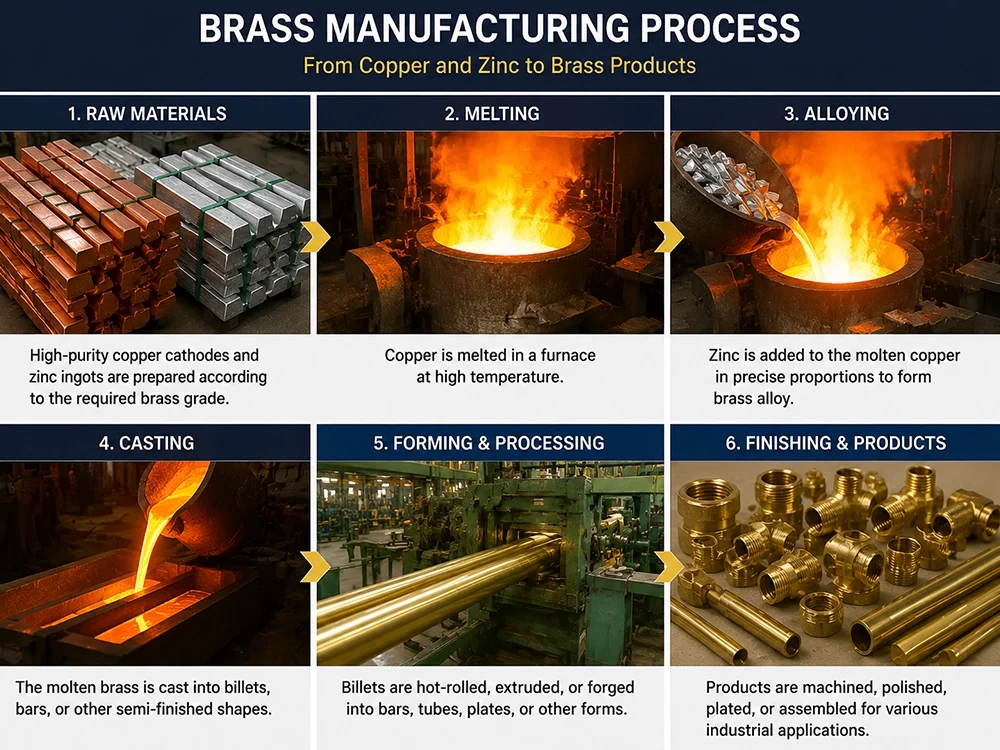
Brass is manufactured by combining copper and zinc through a controlled melting and alloying process. Unlike a simple mixture, industrial brass production requires precise control of chemical composition to achieve the required mechanical properties, corrosion resistance, color, and machinability.
The basic brass manufacturing process includes several key steps:
The largest brass production regions are concentrated in countries with strong copper processing and manufacturing industries, including China, Europe, the United States, Japan, and other industrial economies. These regions supply brass materials for industries such as plumbing, automotive components, electrical equipment, construction hardware, and precision machining.
In simple terms, brass production is the controlled transformation of copper and zinc into an engineered alloy optimized for specific industrial applications.
When purchasing brass materials, engineers often encounter designations such as C36000, C26000, C46400, or C23000. These numbers are not product names but standardized alloy identification codes used to describe the chemical composition and performance category of the material.
The most common system used for copper alloys is the UNS (Unified Numbering System). In this system, brass alloys are generally identified by numbers beginning with the letter “C”, followed by five digits. The UNS designation helps manufacturers, engineers, and buyers identify the correct alloy grade across different suppliers and international markets.
Example | Meaning |
C36000 | UNS designation for free-cutting brass |
C26000 | UNS designation for cartridge brass |
C46400 | UNS designation for naval brass |
C23000 | UNS designation for red brass |
The first letter “C” indicates that the material belongs to the copper alloy family. The following numbers identify the specific alloy composition and grade. For example, C36000 refers to a free-machining brass commonly selected for CNC turned components because of its excellent machinability.
For industrial procurement, specifying only “brass” is usually not enough. Different brass grades may have significantly different machining performance, corrosion resistance, mechanical strength, and regulatory compliance.
A professional material specification should include:
In engineering manufacturing, the brass grade number is the key to ensuring that the selected material matches the product’s performance requirements.
Brass is neither. An element has one type of atom; a compound has atoms chemically bonded in a fixed ratio, like water. Brass is an alloy — copper and zinc atoms mixed within a shared metallic crystal lattice, with no fixed ratio (it varies by grade). Because copper atoms aren't chemically transformed, brass is also not "a compound of copper" — it's a physical/metallurgical mixture, not a chemical one.
Neither has a fixed formula, since both are alloys, not compounds. Brass = copper + zinc (typically 60–70% Cu, 30–40% Zn). Bronze = copper + tin (typically ~88% Cu, ~12% Sn), though modern bronzes may use aluminum or manganese instead of tin. The alloying partner — zinc vs. tin — is what distinguishes them.
Zinc atoms are close in size to copper atoms, causing only mild lattice distortion when alloyed — so atomic layers still slide easily, keeping brass ductile. Tin atoms (used in bronze) are much larger, causing greater lattice distortion that resists slipping. This makes bronze harder and more wear-resistant, but less malleable than brass.
Zinc typically makes up 30–40% of brass, with copper at 60–70%. Both exist as solid metallic atoms within a shared crystal lattice — not chemically bonded. Up to ~35% zinc, they form a single-phase "alpha" solid solution. Above that, a second "beta phase" appears, increasing strength but reducing ductility (as in Muntz Metal).
Red brass is a high-copper alloy — typically 80–90% copper, 10–20% zinc (e.g., C230) — giving it a reddish-gold color and superior corrosion resistance, ductility, and thermal conductivity versus yellow brass. It's commonly used in plumbing, water fittings, and heat exchangers, where corrosion resistance matters more than machining speed or cost.
Brass = copper + zinc (60–70% Cu / 30–40% Zn). Bronze = copper + tin (~88% Cu / ~12% Sn), sometimes with aluminum or manganese instead. Copper is the shared base metal in both; the secondary element — zinc vs. tin — drives the differences in color, strength, machinability, and wear resistance.
Brass is an alloy, not a pure metal. Pure metals (like copper or zinc) contain only one type of atom. Brass combines copper and zinc to create adjustable properties — more copper improves corrosion resistance and ductility; more zinc improves strength and machinability — flexibility that's only possible because it's an engineered alloy, not a single element.
Brass is mostly made of copper (60–70%) and zinc (30–40%). Copper provides corrosion resistance and ductility; zinc adds strength, hardness, and machinability while lowering cost. Some grades also include trace lead, tin, or aluminum for specific properties. The exact ratio varies by alloy — e.g., C360 (~61.5% Cu) for machining, C230 (~85% Cu) for corrosion resistance.
Stop thinking more, fill out the blank below, and send us an inquiry, and you will have a professional team of board game custom products contact you to answer any questions and provide pricing.
You can send us any questions to get any information you would like to know, and we will respond to you in extremely short time.